
Best Fast Payout Online Casinos UK
 Available in GB
Understand the three stages of a withdrawal and why an advertised processing time may not cover the full payment journey.

Table of Contents
- How Fast Payouts Actually Work at UK Online Casinos
- UK Casino Sites That Pay Out Quickly
- What Makes a Casino Payout Fast in the UK?
- Online Casinos With Fast Payout Options
- Fastest Payout Rates: Why the Numbers Need Context
- Highest-Payout Casino Games and What RTP Really Means
- Online Casino Payout Percentages Explained
- The Best Online Slots for Payout Potential
- Why Some Casino Games Show Higher Payout Rates
- Quick Payout Casinos: The Final Checks Before You Deposit
How Fast Payouts Actually Work at UK Online Casinos
When a casino advertises itself as offering fast payouts, the claim usually refers to one specific stage of the withdrawal process: the time between you requesting the withdrawal and the operator approving it. What happens before and after that stage is often outside the casino’s immediate control, and understanding this distinction is the single most useful thing you can know before you judge any speed claim.
The three stages of a withdrawal
A withdrawal from a UK online casino passes through three distinct stages.
Stage one: the request and review. You submit a withdrawal request in the casino’s cashier. At this point the operator reviews the request, which can involve verifying your identity, checking that wagering requirements attached to any bonus have been met, and running anti-money-laundering checks required under the operator’s regulatory obligations.
Stage two: processing and approval. Once the review is complete, the operator approves or rejects the request. This is the stage most "fast payout" claims refer to. A casino that markets itself on speed is, in effect, claiming that this internal review happens quickly.
Stage three: the payment provider’s transfer. After approval, the money moves through whichever payment method you chose — a debit card, an e-wallet such as PayPal or Neteller, or a bank transfer. The operator has no authority over how long the payment network takes. Debit card withdrawals and bank transfers sit with the banking system until they clear; e-wallet transfers generally arrive once the provider processes them on its side.
So when you see a casino promising quick withdrawals, the honest question to ask is: quick at which stage? A casino can approve a request within minutes and still have the money take longer to appear in your account, because the third stage belongs to the payment provider, not the casino.

Why account checks slow things down — and why they exist
The delays that frustrate players most often happen at stage one, and they are not arbitrary. Online casinos operating in Britain must be licensed by the UK Gambling Commission, and that licence carries obligations the operator cannot waive for the sake of convenience. Among them are know-your-customer and anti-money-laundering procedures, which mean the casino must confirm who you are and where your funds came from before releasing money to you.
In practice, this is why your first withdrawal from any casino tends to be slower than later ones. The operator may ask for documents — proof of identity, proof of address, evidence of the payment method you used. Once your account is verified, subsequent withdrawals usually move faster, because the checks have already been done.
This is also why two players at the same casino can have very different experiences. A player with a long-established, fully verified account withdrawing to a method they’ve used before will typically see money move faster than a new player making a first withdrawal after a large win. The casino isn’t treating them differently on a whim; the regulatory burden differs.
What the operator actually controls
Operators differ in their game libraries, deposit options, and withdrawal arrangements — a point that any detailed operator review makes when comparing sites. Those differences are where the real distinction between a genuinely fast casino and a slow one lies:
- How withdrawals are queued and reviewed. Some operators review requests continuously; others batch them. The first approach puts approval in front of the payment network faster.
- Which withdrawal methods are offered. A casino that supports e-wallet withdrawals alongside debit cards gives you a route that doesn’t wait on bank clearing times. One that only offers card and bank withdrawals caps how quickly money can physically reach you, no matter how fast the internal approval is.
- Whether the payment method you deposited with is available for withdrawal. Many operators return funds to the source of the deposit, which means your withdrawal route may already be determined by how you paid in.
- How transparently processing times are disclosed. Operators are required to disclose their payment processing practices, so a casino that hides its withdrawal times behind vague language is telling you something before you ever deposit.
The safeguard behind the speed
There is a tension at the heart of fast payouts that is worth stating plainly. The checks that slow a withdrawal down — identity verification, source-of-funds queries — are the same checks that protect you and the wider system from fraud and money laundering. A casino that somehow skipped them would indeed be faster, and would also be in breach of its licence. The UKGC can pull licences or impose penalties on operators that deviate from their duties, which is precisely why no licensed operator treats speed as a licence to cut corners.
The same regulatory framework touches the games themselves: UK regulators require independent auditing of random number generators, so the outcome of your play — and therefore the winnings you eventually withdraw — is produced by systems that have been checked by parties with no stake in the result. The randomness of the game and the integrity of the cashier are two sides of the same licence.
Withdrawal Stages
- Request & Review
- Processing & Approval
- Payment Provider Transfer
Key Regulation UK Gambling Commission (UKGC)
Major Delay Factor Identity & AML verification
What this means for comparing casinos
Once you understand the three stages, comparing casinos becomes a matter of asking the right questions rather than trusting the fastest-sounding headline. The useful comparisons are about what the operator controls: which withdrawal methods are available, how quickly requests are reviewed, whether verification is done up front or deferred until you try to cash out, and how clearly the casino explains all of this before you deposit.
The less useful comparisons are the ones that promise a single number for "how long a withdrawal takes", because that number depends on your account status, your payment method, and the banking system — none of which is a fixed property of the casino.
With that framework in place, the next section looks at what separates the UK casino sites that consistently pay out quickly from those that merely claim to.
UK Casino Sites That Pay Out Quickly
Every UK casino site advertises quick withdrawals, which is exactly why the phrase tells you nothing on its own. What separates one cashier from another is not the marketing claim but a set of concrete, checkable features: which payment methods the operator supports, how the withdrawal route works, what happens to money that never reaches your account, and whether the operator is obliged to tell you any of this in the first place.

This section covers those cashier-side characteristics. If you want the mechanics of how a withdrawal is processed once you press the button, the previous section handles that; here the focus is on what distinguishes one site from another before you ever reach that button.
The licence comes before the cashier
The baseline feature of any UK casino site worth depositing at is a UK Gambling Commission licence. That is not a quality badge — it is a legal requirement for any operator offering online gambling to consumers in Great Britain, regardless of where the company is based. The Gambling (Licensing and Advertising) Act tightened the path to obtaining a licence, and operating without one is a criminal offence.
The licence matters for payouts specifically because it comes with obligations an unlicensed site simply does not have. Licensed operators must disclose their payment processing practices, must implement anti-money-laundering and know-your-customer policies, and must handle complaints through a defined procedure. A cashier at a licensed site cannot quietly change withdrawal terms and leave you with no route to challenge it. You can also verify any licence yourself: the UKGC maintains a public register of operating licences, and you can check the operator’s name or licence number against it, confirming the domain listed matches the one you are playing on.
Payment options: where differences actually appear
Casino sites differ in the practical details of their cashiers, and those differences matter more than any speed claim. According to profile reviews of UK casino operators, sites vary in three areas in particular: their game library, their deposit options, and their refund options.
E-wallets like PayPal and Neteller are widely offered alongside debit cards.
Your chosen withdrawal method often depends on the method used for your initial deposit.
Procedures for failed or returned transactions are outlined in the site’s terms of use.
What that means in practice:
- Deposit methods. E-wallets such as PayPal and Neteller are widely offered alongside debit cards. One restriction is fixed in regulation rather than left to the operator: credit cards cannot be used to pay for gambling in Great Britain, and an operator may not accept a payment through an e-wallet unless the wallet provider can demonstrably prevent credit card funding. Any site suggesting otherwise is either unlicensed or misleading you.
- Withdrawal routes. The method you used to deposit often determines what is available for withdrawal. A site that supports several e-wallets and debit cards gives you more routes out of the cashier than one relying on a single method — and if your preferred method is unavailable for withdrawals, that is a limitation worth knowing before you deposit, not after.
- Refund arrangements. This is the least glamorous and most overlooked area. If a transaction fails, a deposit is duplicated, or a withdrawal is returned to your account, the operator’s refund procedure determines how the situation is resolved. Because operators are required to disclose payment processing practices, the terms covering failed and returned transactions should be findable in a site’s terms of use. If they are not, that silence is information.
What "same day" and "instant" actually mean here
Search for casinos that pay out instantly in the UK and you will find two different promises wearing the same words. Some sites mean that a withdrawal is approved and processed within the same day you request it, provided your account has already passed identity checks. Others mean that the internal approval step is fast but the payment then travels through a bank or card network whose schedule the casino does not control.
Both can honestly be described as quick. Neither is a guarantee, and no licensed operator can promise you one, because the operator does not operate the entire chain. A useful habit is to read a site’s stated processing disclosures — which the operator is required to publish — and treat anything beyond those disclosures, particularly in advertising copy, as a claim rather than a commitment.
The other practical limit is the account itself. Withdrawals above certain thresholds can trigger additional source-of-funds checks under a site’s anti-money-laundering policies. This is not the operator being difficult; it is a condition of the licence, and it applies at every UK-licensed site. A cashier that never asks any questions is a cashier operating without those obligations — which is a different and worse problem.
Speed claims versus game selection
It is worth separating two things that often get bundled together in searches: how fast a site pays out, and how generous its games are. They are different measurements. UK online casinos offer slots, blackjack, roulette, live dealer games, scratchcards and poker rooms, and the payout behaviour of a game has nothing to do with how quickly the cashier releases your winnings. Slots rely on random number generators and stated RTP figures; the cashier relies on payment processors and compliance checks. A site can have an excellent game library and a slow cashier, or the reverse.
The single-source survey data on player game preferences — and on how often jackpots trigger — belongs elsewhere in this guide, alongside the fuller explanation of RTP. For choosing a site that pays out quickly, the game library is a secondary question. The primary questions are about the cashier.
A short checklist for the cashier
Before depositing at any UK casino site, the payout-relevant checks come down to this:
- Confirm the UKGC licence against the public register, matching the operator name and licence number to the domain.
- Read the payment disclosures. Licensed operators must publish their payment processing practices — find them before depositing, not when a withdrawal is pending.
- Check the withdrawal methods, not just the deposit ones, and confirm your preferred route out is supported.
- Look for the refund procedure. How the site handles failed transactions and returned payments should be documented in its terms.
- Check the player-control tools. Licensed sites must let you set deposit limits, take breaks and self-exclude, and all remote operators must be members of GAMSTOP, the national self-exclusion scheme. A site offering these tools is demonstrating it operates inside the regulatory framework that also governs its cashier.
None of these steps tells you a withdrawal will land within any particular number of hours. What they do is establish whether the site is subject to the obligations that make a payout claim enforceable — and whether the cashier you are trusting with your money answers to anyone at all. That is the foundation everything else, including speed, sits on.
What Makes a Casino Payout Fast in the UK?
"Fast payout" is one of those phrases that means different things depending on who is saying it. An operator’s marketing page and a player waiting for money to appear in their bank account are describing two different events. This section separates what genuinely affects payout speed at UK casinos from the claims that sound good but explain nothing.
What "fast" actually measures
A withdrawal is not a single action. It begins when you request it, passes through the operator’s internal checks, then moves through a payment provider before it reaches your account. A casino can only honestly claim speed for the part it controls: how quickly the request is reviewed and released. Once the money leaves the operator’s side, the payment route takes over, and different routes move at different speeds. A casino advertising quick withdrawals is usually describing its processing stage, not promising the moment of arrival.
A casino can only control the speed of its internal review and approval stage, not the time taken by the payment provider to move funds to your account.
This matters because the vague version of the claim — "instant withdrawals", "cashouts in minutes" — collapses all of those stages into one. The honest version distinguishes them, and a casino that discloses its payment processing practices is meeting an obligation, not doing you a favour.
Why some checks are not optional
The inconvenient part of payout speed is that some of the delay is the point. Online casinos operating in Britain must be licensed by the UK Gambling Commission, and that licence comes with duties that slow things down by design. Operators must implement AML and KYC procedures — identity checks, source-of-funds questions in some cases, and anti-money-laundering controls. These are not friction to be engineered away in the name of speed; they are conditions of operating at all.
A withdrawal that arrives with no checks at any point is not a sign of efficiency. It is a sign that something in the process is missing. The same regulatory framework requires independent auditing of random number generators, which has nothing to do with withdrawals directly but tells you what kind of oversight the licence imposes across the whole operation. A licensed casino is being watched on several fronts at once, and payout handling is one of them.

Speed claims versus payout rates
A separate confusion sits inside the search itself: "best payout" and "fast payout" get used as if they meant the same thing. They do not. Payout rate in the slot context refers to RTP — the theoretical return of a game. An RTP of 95% means that over a very long period and many plays, a slot returns £95 for every £100 wagered in total. That figure describes the mathematics of a game across everyone who plays it, over time. It says nothing about how quickly a casino hands over your money when you press the withdrawal button.
So a casino could run high-RTP games and still be sluggish at the cashier, or process withdrawals briskly while offering games with modest return rates. Treating one as evidence of the other leads to disappointment on both sides.
Reading a speed claim before trusting it
When a casino says it offers fast payouts, the useful questions are the unglamorous ones:
- Does it disclose its payment processing practices, including how withdrawal requests are reviewed?
- Is it licensed by the UK Gambling Commission, and does the licence check out against the public register?
- Which withdrawal routes does it offer, and does it state their limits honestly rather than burying them?
- Does it let you set deposit limits, take a break, or self-exclude — the player controls a licensed site must provide?
A payout is only fast if it is fast and legitimate. The checks that protect you during a withdrawal are the same ones that make absolute speed impossible. Any operator promising the second while quietly skipping the first is not offering you a better service — it is offering you less protection dressed up as convenience.
Online Casinos With Fast Payout Options
When you compare UK casinos on withdrawal speed, you are really comparing cashier policies. Two licensed operators can run identical games on identical software and still get your money to you at noticeably different speeds, because the withdrawal route — not the games — is where they differ. A profile review of a single operator makes the same point from the other direction: online casinos differ in their game library, deposit options, and refund options, and those differences sit in the cashier rather than on the reels.
- Verify the UKGC licence on the public register.
- Read the operator’s payment processing disclosures.
- Confirm your preferred withdrawal method is supported.
- Rely solely on “instant” or “same day” marketing claims.
- Assume high RTP means faster cash-outs.
- Use credit cards for gambling deposits.
What actually varies between operators
The withdrawal side of a casino is a set of choices the operator has made, and each one affects you differently:
- Which payment methods are available for cashing out. A casino that accepts PayPal, Neteller or a debit card for deposits does not necessarily support all of them for withdrawals. This is stated in the cashier terms rather than the marketing copy, so it’s the first place to look.
- Whether the same route is used both ways. Some operators require you to withdraw by the same method you deposited with. If that method doesn’t support payouts at all, you’ll be redirected to a bank transfer, which is rarely the fast option.
- How refund arrangements are worded. In industry terms, a withdrawal is a refund of your deposit and winnings. How an operator handles refunds — whether funds return to source automatically or you must request it — is described in the operator’s own terms, and it differs from site to site.
- Whether real-money play supports your currency. A review of one operator’s real-money offering notes that players can stake cash or other accepted currencies. If your account currency isn’t among the accepted ones, the payout conversation changes shape before it begins: you’re now looking at conversion as well as transfer time.
The gap between "instant" and "same day"
Search results promise instant payouts, and some casinos do process approved withdrawals within minutes. But the word "instant" applies to the processing step, not to the whole journey. Once the operator releases the funds, the payment method takes over, and that leg of the trip runs on the provider’s schedule, not the casino’s. A withdrawal approved instantly to a debit card still has to clear the card network; one approved instantly to an e-wallet has to clear the wallet provider. The casino controls only the first stage.
That distinction is worth holding onto when a new fast payout casino launches in the UK. A new site has an incentive to lead with speed claims, because it doesn’t yet have the reputation that older operators rely on. A speed claim you can verify in the cashier terms — which methods are supported, whether verification is already complete — is worth more than a banner. A claim you can’t verify is worth exactly what it costs the site to print.
Reading the options before you deposit
The practical approach is to check three things before your first deposit rather than after your first win: which withdrawal methods the operator actually supports, whether your account is fully verified, and what the terms say about refunds to your original payment method. Under UKGC rules, operators must disclose their payment processing practices, so this information is available — it just isn’t always in the most prominent place on the site.

Casinos also differ in game selection, and later sections of this guide deal with which games pay best over time. But withdrawal speed is decided in the cashier. Choosing an operator means choosing a payment route, and the two decisions deserve the same amount of attention.
Fastest Payout Rates: Why the Numbers Need Context
Search for the fastest payout casino in the UK and you will meet two very different numbers wearing similar clothing. One is the payout rate — the percentage a game is designed to return over time. The other is the payout time — how long a withdrawal actually takes to reach your bank account. They measure separate things, and confusing them is the single most common mistake players make when comparing operators.
What a payout rate actually tells you
A payout rate, usually expressed as RTP (return to player), describes a game’s long-run behaviour, not your session. An RTP of 97% theoretically returns £97 for every £100 spent on the slot. An RTP of 95% means that over a very long period and many plays, a slot returns £95 for every £100 wagered in total.
Notice the qualifiers: theoretically, over a very long period, wagered in total. Online slot outcomes are random, so RTP examples are theoretical rather than guaranteed returns. The percentage is drawn from millions of spins, during which individual players will win well above the rate, well below it, or nothing at all. A rate does not tell you what will happen to your £50 on Tuesday evening.
RTP
Return to Player (RTP) is a theoretical percentage describing the amount a game is designed to return to players over a very long period of play.
What a payout rate cannot tell you
Nothing about speed. A casino could advertise games with the highest RTP figures on the market and still take longer than a competitor to process your withdrawal — because the rate lives in the game and the delay lives in the cashier, the verification checks and the payment route. These are different departments answering to different rules.
So when a site markets itself as the fastest payout online casino in the UK, the claim is about processing, not about the games it offers. And when a site promotes its payout rates, the claim is about game mathematics, not about how quickly you will see the money. Neither claim proves the other.
How to read both numbers honestly
When comparing casinos, treat the two figures as separate questions:
- Payout rate question: what does this game return over millions of plays, and is that rate verifiable? Under UK Gambling Commission rules, random number generators must be independently audited, so the figure should come from a testable source rather than marketing copy.
- Payout time question: what happens between clicking “withdraw” and the money landing — which checks apply, which payment routes are involved, and what does the operator’s own disclosure say about processing?
The uncomfortable part is that a rate alone cannot establish how quickly money reaches a player, and a headline about speed says nothing about the games behind it. Sites that blur the two — implying that a high RTP means fast cash-outs, or that quick processing means generous games — are borrowing credibility from a number that does not belong to their claim.
Read the two figures side by side, ask which of the two questions each one answers, and be suspicious of any casino that answers both with the same number.
Highest-Payout Casino Games and What RTP Really Means
Search for the highest-paying casino games in the UK and you will quickly run into a wall of percentages. A slot advertises a return to player of 97%, and it sounds like a promise: put in £100, get back £97. That reading is wrong, and understanding why is the difference between using RTP as a tool and being misled by it.
What the RTP figure actually is
RTP stands for return to player. It is a theoretical figure built into the game’s design, not a running tab on your personal account. An RTP of 97% means the slot is constructed to return £97 for every £100 spent on it — spent in total, by everyone playing, across an enormous number of spins.

The mechanism behind every outcome is a random number generator. Online slot outcomes are random, and the output cannot change depending on the scenario you are in: the machine has no memory of your previous spins and no opinion about how much you have lost. What the RNG produces in any single spin is independent of everything before it.
This is why RTP examples are theoretical rather than guaranteed returns. The £97-per-£100 figure describes a long-run average. In the short run — which is to say, the session you actually play — outcomes can sit far from that average in either direction. A game with a 97% RTP can eat £50 in ten minutes; it can also pay out several times your stake in one spin. Neither result tells you anything about whether the figure is honest.
Why one big win proves nothing
The randomness is the uncomfortable part of the pitch. When a game is described as a high-payout slot, what is usually meant is that its RTP figure is relatively high compared with other slots. That is a statement about the game’s long-term construction, not about your next spin.
It also works in aggregate, not per player. The theoretical return is spread across all wagers on the game everywhere. One player’s jackpot and another player’s empty session are both consistent with the same RTP. So the question "which UK casino has the highest payout?" has a misleading premise when it’s asked about games: no casino can route you to a slot that returns more than its design allows, and no session is owed the average.
Important Note A high RTP figure describes the mathematical design of a game, but it provides no guarantee of your individual session results or how quickly you will be paid.
How to use RTP without being fooled by it
Treated correctly, RTP is one of the more useful pieces of information on a game’s paytable screen. A few things are worth keeping straight:
- It is a comparison figure. Its value is in letting you see that one game is built to return more than another over the long run — nothing more granular than that.
- It is not a schedule. It does not mean you will receive a steady trickle of returns, and it does not cap how much a single spin can pay.
- It is not affected by how you play. Because outcomes come from a random number generator, there is no pattern of stakes, timings or rituals that nudges the return in your favour.
- It is not a guarantee of a session result. Any claim that a game “pays out” at a stated rate on demand misrepresents what the number measures.
The honest way to read a high RTP is as a lower expected cost per pound wagered over time, not as a higher chance of walking away up tonight. Those are different claims, and only one of them is true.
What this means for high-payout searches
If you are comparing games on RTP, compare like with like: the figure is defined per game, so a 97% slot is built to return more over the long run than a lower-RTP slot under the same conditions. But the gap between the two only shows up reliably over a very long period and many plays — a horizon no individual session reaches.
None of this makes RTP useless. It makes it a design specification, the way fuel consumption figures describe a car rather than your next journey. The number belongs to the game; the outcome of any given spin belongs to chance.
Online Casino Payout Percentages Explained
Search for the best online casino payout percentages in the UK and you will quickly notice that every slot and casino review leads with a number. The number is usually labelled RTP — return to player — and it is worth understanding precisely what it does and does not promise before you attach any weight to it.
What an RTP percentage actually describes
An RTP of 95% means that over a very long period and many plays, a slot returns £95 for every £100 wagered in total. The key words there are "over a very long period and many plays". The percentage is a description of total turnover, not of your session.
If you wager £100 across a number of spins, nothing obliges the slot to hand back £95 of it. Your individual result can sit well above or well below the figure, because the percentage only settles into place across an enormous volume of play. A casino with thousands of players will see its aggregate returns drift towards the published RTP; a single player on a single evening is one small sample of a very long sequence.
Why the randomness matters
Online slot machines use random number generator technology to ensure randomness, and the "random" part deserves as much attention as the "percentage" part. Slot machines exclusively feature output randomness, meaning the output cannot change depending on a particular scenario. The machine does not warm up after a losing run, does not hold back after a win, and does not adjust itself to a target for the day. Each spin is generated independently of the last.
Understanding Randomness
- Slot outcomes are generated by independent random number generators.
- The machine has no memory of previous spins or player losses.
- Payout percentages represent long-run averages, not short-term schedules.
This is also why payout percentages cannot be read as a schedule of returns. A figure tells you how the game is constructed over time; it tells you nothing about what happens in the next ten minutes. Anyone presenting a slot’s percentage as a likely outcome for an individual player is describing something the game, by design, cannot offer.
Reading the numbers the way they are meant to be read
When you compare payout percentages across online casinos and slots, a few habits help:
- Treat the percentage as a long-run property. It describes total wagers over total plays, not a promised return on your deposit.
- Compare like with like. A percentage for a slot and a percentage quoted for a casino overall measure different things, and one should not stand in for the other.
- Remember the sequence is random. Because outputs are independent, past results give no information about the next spin — including the results that happen to follow a long losing streak.
The percentage on a slot is honest information, but it is honest about the long run. It says nothing about any particular session, and any reading of it that expects otherwise will end up disappointed by mathematics rather than by the casino.
The next section narrows the focus further, from percentages in general to the specific slot formats that shape how wins arrive — but the underlying rule carries through: the numbers describe construction, not experience.
The Best Online Slots for Payout Potential
This page highlights UK online casino options for players who prioritise fast payouts in 2026. Use the listed payout times, bonuses, licensing information and minimum deposits as a quick guide when reviewing each option.
License: UKGC Operator Licence · Bonus: £200 welcome bonus · Payout speed: Within 48 hours · Min. deposit: £10 32Red holds a UKGC Operator Licence and offers a £200 welcome bonus. Its stated payout speed is within 48 hours, with a £10 minimum deposit.
License: UKGC Operator Licence · Bonus: £100 bonus · Payout speed: Within 24 hours · Min. deposit: £10 ProgressPlay Limited is licensed by the UKGC and offers a £100 bonus. Payouts are stated to arrive within 24 hours, and the minimum deposit is £10.
License: UKGC Operator Licence · Bonus: £20 bonus · Payout speed: Within 48 hours · Min. deposit: £10 Silverbond Enterprises operates under a UKGC Operator Licence and provides a £20 bonus. Its stated payout speed is within 48 hours, with a £10 minimum deposit.
License: UKGC Operator Licence · Bonus: £100 bonus · Payout speed: Within 24 hours · Min. deposit: £10 Genesis Global Limited is a UKGC-licensed operator offering a £100 bonus. It lists payouts within 24 hours and a £10 minimum deposit.
License: UKGC Operator Licence · Bonus: £100 bonus · Payout speed: Within 24 hours · Min. deposit: £10 LeoVegas holds a UKGC Operator Licence and offers a £100 bonus. The stated payout speed is within 24 hours, with a £10 minimum deposit.
License: UKGC Operator Licence · Bonus: £50 bonus · Payout speed: Within 48 hours · Min. deposit: £10 Platinum Gaming Limited is licensed by the UKGC and offers a £50 bonus. Its stated payout speed is within 48 hours, and the minimum deposit is £10.
When people search for the best payout slots, what they are usually looking for is a game that pays often and pays well. No slot can promise either, because online slot machines use random number generators to produce unpredictable outcomes. What you can judge before you play is how a game is built — and slot mechanics shape the way wins actually arrive.
How reels and paylines change the experience
Slot games typically display three to five reels containing symbols that may award prizes or trigger bonus rounds. On a traditional three-reel game, wins tend to be simple: matching symbols on a limited set of lines. Players can select their desired stake and the number of active paylines, which means the same game can behave differently depending on how it is configured.
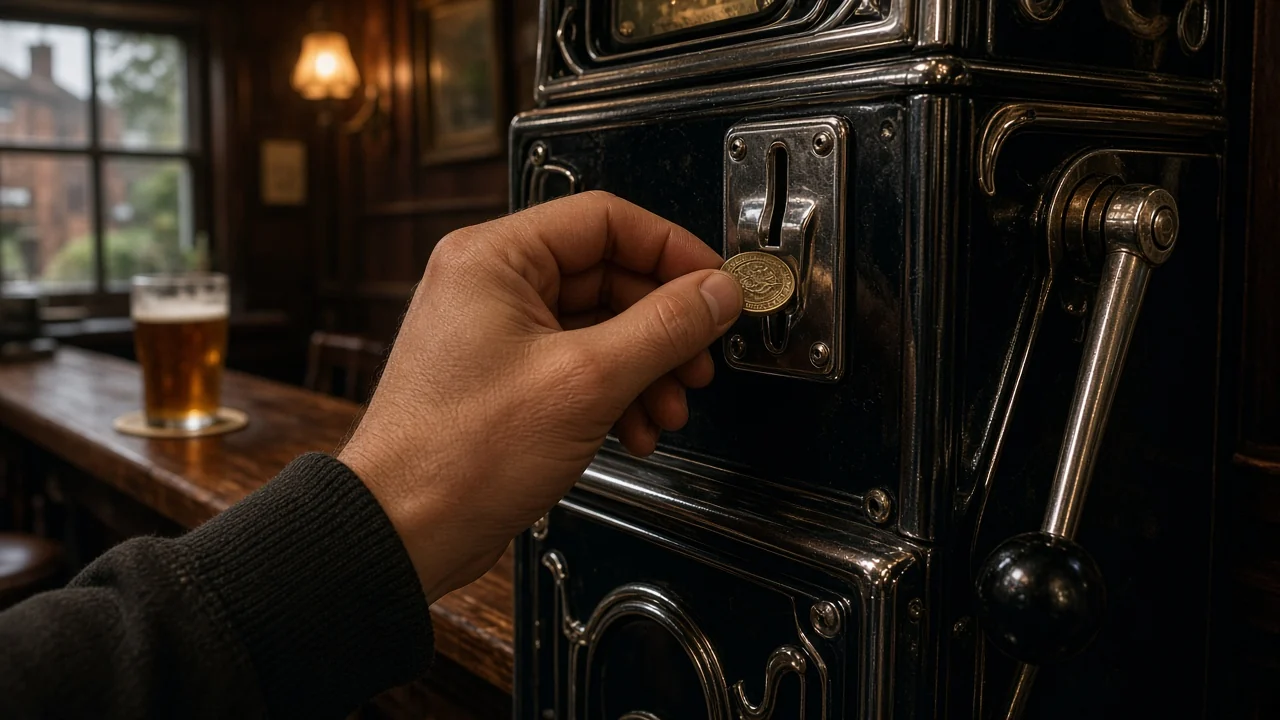
Modern multi-line slots work differently. According to a specialist casino review, some Megaways games offer over 100,000 different paylines. That does not mean more money — it means more small combinations landing more often, against stakes that cover a far larger number of potential lines. The classic UK term for the simple machines found in pubs and clubs, the fruit machine, describes the opposite end of this spectrum: one coin at a time, a small number of ways to win, and a clear picture of what you are paying for.

Flat tops versus progressive jackpot slots
Flat-top jackpot machines offer a fixed top prize, so the maximum payout is known in advance and does not grow while you play. Progressive jackpot slots take the other approach: the prize increases as players around the world spin the reels, and, according to the same type of specialist review, progressive prizes can reach thousands of pounds.
The trade-off matters more than the headline. Progressive jackpots have an extremely low probability of a player winning the jackpot, and they are triggered at random rather than by anything a player does. Popular Science has reported that such jackpots may be triggered only once a month after reaching a specified amount — a single-source claim about individual games, not an industry rule, but it gives a sense of the scale. The overwhelming majority of spins on a progressive game pay nothing from the jackpot itself.
What to look at instead of the jackpot figure
If your priority is a steady stream of smaller results, the games that suit you are the ones built for frequency: multiple paylines, modest fixed prizes, and bonus rounds that trigger regularly. A survey cited by Popular Science found that more than 60% of slot machine players preferred frequent smaller payouts to larger infrequent ones, while 33% of gamblers preferred progressive jackpot slots. Both preferences are legitimate — they just point at different machines.
Before you play any slot, two checks are worth making. First, confirm the operator holds a UK Gambling Commission licence, since every legitimate slot in the British market sits behind that requirement. Second, look at the game’s published RTP alongside its format: a game with a high rate but a single random jackpot will feel very different from a multi-line slot with the same rate and no jackpot at all. The rate tells you the long-run expectation; the mechanics tell you how that expectation is delivered.
Why Some Casino Games Show Higher Payout Rates
When you compare the payout rates attached to different casino games, the differences are rarely random. Most of them trace back to how a game is built, who paid to license it, and what kind of prize it is trying to sell. Knowing the reasons behind a headline figure is more useful than the figure itself.
Why branded slots have lower RTP
Branded slots often feature lower RTPs because a portion of every wager goes toward paying for the rights to use popular films, video games, or pop-culture properties.
The branded slot problem
Branded slots — games built around Hollywood films, famous video games and other pop-culture properties — often show low RTP and fewer extra features than comparable unbranded titles. The reason is structural rather than mysterious: part of what each wager returns goes to the rights holder rather than to the player. A familiar title on the cabinet is a marketing asset, and the cost of that asset is baked into the game’s mathematics. A slot carrying a film licence and a modest RTP is not an anomaly; it is the expected outcome of that arrangement.
Progressive jackpots and the trade you are making
Progressive jackpot slots sit at the other end of the design spectrum. Their jackpots grow because players around the world spin the reels, and specialist casino reviews report that prizes can climb into the thousands of pounds. But the probability of any individual player landing the jackpot is extremely low — that is not a complaint about any particular operator, it is how the format works by design. Every spin that does not win the top prize contributes to a pool that one player eventually collects.
Some progressive games compensate by trimming the base-game return to fund the prize pool, which is why a progressive slot and a flat-top slot can carry noticeably different rates while offering a similar everyday playing experience. The flat-top machine pays a fixed top prize; the progressive converts a slice of every wager into a long-odds ticket.
What a high rate does and does not tell you
A high payout rate is a statement about the game’s long-run structure, not about your session. It tells you nothing about when a win will land, how large it will be, or whether the game’s features — free spins, bonus rounds, multipliers — suit the way you like to play. Two games with identical rates can feel completely different if one pays rarely and heavily while the other pays small amounts steadily.
So when a game is advertised with an impressive percentage, the useful questions are the inconvenient ones: is it branded, is it progressive, and what is the rate funding? The number on its own never answers those questions.
Quick Payout Casinos: The Final Checks Before You Deposit
A casino can call its payouts "quick" in an advert and still leave you waiting. Before you deposit anywhere, three checks are worth doing — and none of them take long.
Check the licence first. Any online casino operating in Britain must be licensed by the UK Gambling Commission, wherever in the world it is actually based. Don’t rely on the licence logo at the bottom of the homepage: open the UKGC’s public register, search the operator’s name or licence number, and confirm the domain listed there matches the site you’re on. If it doesn’t match, the site is either unlicensed or pretending to be someone else, and operating without a UKGC licence is a criminal offence — not a grey area.
While you’re at it, remember that UK regulators require independent auditing of random number generators. A licensed operator has had that audit; an unlicensed one has, at best, made a promise.
Check the payment rules. Licensed UK operators must not accept payment by credit card — including payments routed through an e-wallet funded by credit. This restriction exists to stop you gambling with money you don’t have, and it also tells you something useful: a site happily taking credit-card deposits is not following UK rules, so its withdrawal promises are worth little. Operators must also disclose their payment processing practices, so the terms should state clearly how withdrawals are handled. If that information is hard to find, treat it as an answer.
Beyond the rules, operators genuinely differ in their game libraries, deposit options and refund options — according to at least one detailed casino review site, these differences are often larger than the payout-speed claims themselves. The withdrawal method you can actually use matters more than the headline speed.
Check the player-control tools. A licensed UK site must prompt you to set a deposit limit before your first deposit, and it must let you take a break or self-exclude. Every remote operator must also belong to GAMSTOP, the national self-exclusion scheme. Two further obligations matter for withdrawals specifically: you must be able to stop playing at any time and retain your remaining deposit and winnings earned from it, and any operator that makes reclaiming your own money difficult is worth walking away from — before you’ve given them any.
None of these checks tells you how fast a payout will land. Together, they tell you whether the payout promise is enforceable at all — which is the more useful thing to know.
Which type of slot has the highest RTP?
An RTP of 97% theoretically returns £97 for every £100 wagered, but RTP is not guaranteed for individual players. Branded slots often have lower RTP than other types.
Do I need to deposit to use these spins?
No, some casinos offer demo mode without wagering funds. Real-money play requires you to stake cash or another accepted currency.
Do I need a license to operate a crypto casino?
Yes, online casinos operating in Britain must be licensed by the UK Gambling Commission. The licensing requirements apply to the operator rather than the payment currency.
Can I use a credit card at a UK casino?
The available payment methods differ between casinos. Operators may offer debit cards, e-wallets such as PayPal or Neteller, and bank transfers, while your withdrawal route may be linked to the method used for depositing.
Is PayPal accepted at UK gambling sites?
Some UK casinos offer PayPal as an e-wallet withdrawal method, but payment options vary between operators. Check the casino’s cashier and payment terms before depositing.
Is cryptocurrency accepted for iGaming deposits in the UK?
Payment options differ between casinos, and the available deposit methods are set by each operator. Check the casino’s stated payment options before depositing.
Prepared by the Casinouk Game Info editorial staff.