
Safe Online Casino UK: How to Check Operators
 Available in GB
A practical guide to UKGC licences, secure payments, fair games, bonuses, withdrawals and casino apps.

Table of Contents
- What Makes an Online Casino Safe in the UK?
- UKGC Licensing: How to Check the Operator Behind a Casino
- Licensed Casino Sites and White-Label Operations
- Safe Online Casinos for Real-Money Play
- How to Choose a Safe and Reliable Online Casino
- Finding a Legitimate Casino Bonus Without Missing the Conditions
- Secure Casino Payments, Including Crypto Questions
- Safe Casino Games and Online Slots
- Safe Deposit Methods and Casino Withdrawals
- Safe Casino Apps: What to Check Before Installing
What Makes an Online Casino Safe in the UK?
When people talk about a safe online casino, they usually mean one of two things: the site won’t steal your money, and the games won’t be rigged against you. In the UK, both of those concerns are addressed by a single system of regulation, and once you understand how it works, judging whether a casino is safe stops being a matter of gut feeling and becomes a matter of checking a short list of things.
The foundation of everything is the UK Gambling Commission (UKGC). It regulates all forms of gambling in the United Kingdom, and any site offering online casino games to players in Great Britain must hold a valid UKGC licence to operate legally — regardless of where the company itself is based. This is the single most important fact about casino safety in the UK: a licence isn’t an optional seal of quality that some casinos choose to display. It’s the legal permission to operate at all, and it comes with obligations the operator cannot opt out of.
This list highlights key facts to consider when choosing a safe online casino in the UK in 2026. Use the details below to quickly review licensing, welcome offers, payout times and minimum deposits.
License: UKGC Operator Licence · Bonus: £200 welcome bonus · Payout speed: Within 48 hours · Min. deposit: £10 32Red holds a UKGC Operator Licence and offers a £200 welcome bonus. Payouts are stated as available within 48 hours, with a £10 minimum deposit.
License: UKGC Operator Licence · Bonus: £100 bonus · Payout speed: Within 24 hours · Min. deposit: £10 ProgressPlay Limited is listed with a UKGC Operator Licence and a £100 bonus. Its stated payout speed is within 24 hours, and the minimum deposit is £10.
License: UKGC Operator Licence · Bonus: £20 bonus · Payout speed: Within 48 hours · Min. deposit: £10 Silverbond Enterprises holds a UKGC Operator Licence and provides a £20 bonus. Payouts are stated as available within 48 hours, with a £10 minimum deposit.
License: UKGC Operator Licence · Bonus: £100 bonus · Payout speed: Within 24 hours · Min. deposit: £10 Genesis Global Limited is licensed by the UKGC and offers a £100 bonus. The stated payout speed is within 24 hours, and the minimum deposit is £10.
License: UKGC Operator Licence · Bonus: £100 bonus · Payout speed: Within 24 hours · Min. deposit: £10 LeoVegas holds a UKGC Operator Licence and offers a £100 bonus. Payouts are stated as available within 24 hours, with a £10 minimum deposit.
License: UKGC Operator Licence · Bonus: £50 bonus · Payout speed: Within 48 hours · Min. deposit: £10 Platinum Gaming Limited is listed with a UKGC Operator Licence and a £50 bonus. Its stated payout speed is within 48 hours, and the minimum deposit is £10.
Licensing is the floor, not the ceiling
A UKGC licence obliges the operator to do several concrete things, and each of them maps directly onto a risk a player would otherwise carry alone.
Responsible gambling tools. Every UKGC casino must provide tools for responsible gambling, including deposit limits, session limits, loss limits and self-exclusion options. This matters for safety in a practical sense: you can decide in advance how much you’re prepared to lose and have the site enforce that decision, rather than relying on your own discipline at midnight with a losing streak behind you. The tools are not hidden behind support tickets — the licence requires them to be available to you directly.
Transparent terms. UKGC casinos must offer transparent terms and conditions, with clear information on bonuses, withdrawal policies and verification requirements. The point of this requirement is to remove the classic trap where a promotional offer looks generous until you read the conditions attached to it, or where a withdrawal is delayed for reasons the player was never told about. A licensed site can still have strict terms — it just has to state them in a form you can actually read before committing.
Complaints handling and ADR. If a dispute arises, a UKGC casino cannot simply ignore you. It must provide access to Alternative Dispute Resolution (ADR) services for player complaints, which means an independent body can review the dispute if the casino’s own response doesn’t resolve it. Unlicensed sites have no such obligation; when something goes wrong there, the only recourse is a chargeback attempt or a loss.

Age and identity checks. The minimum age for online gambling in the UK is 18, and casinos must verify players’ age and identity through KYC (Know Your Customer) checks before allowing gambling. This serves two purposes: it keeps the site inside the law, and it protects you from someone else using your identity to gamble. Verification sometimes feels intrusive — uploading a passport or a bank statement is nobody’s idea of fun — but a casino that never asks for it is a casino operating outside the rules.
What "safe" does not mean
It’s worth being precise about what a licensed casino does and doesn’t guarantee.
A UKGC licence means the operator is accountable: it must follow rules on fairness, player information and complaint handling, and it can lose its licence for failing to do so. It does not mean you will win, that any particular bonus is worth taking, or that every licensed site is equally pleasant to use. There are competent licensed casinos and clumsy ones. Safety, in the regulatory sense, is about the floor — the minimum protections that apply to you as a player — not about the quality of what’s built on top of it.
- Check the operator’s legal name on the UKGC register
- Verify that the licence covers the specific domain you are visiting
- Set deposit, session, and loss limits before playing
- Trust a casino based solely on its branding or a Union Jack logo
- Assume a site is licensed just because it looks professional
- Ignore the difference between a brand name and the legal operator
It also doesn’t mean every site with a British-looking name is licensed. Branding is cheap; a Union Jack in the header proves nothing. What proves something is the licence itself, and licences are held by operators — legal companies — rather than by whatever name appears on the homepage. Checking the operator behind the casino against the UKGC’s public register is the most reliable verification step available, and it’s covered in detail later in this guide.
The player’s side of the bargain
Regulation puts obligations on operators, but it works best when players understand what it covers. A few things to hold onto:
- A licence covers the operator, not the marketing. Reviews, rankings and advertisements are not regulated the same way the casino itself is. Judge the licence, then judge the offer.
- Complaints have a route. If a casino fails to resolve an issue, ADR exists precisely for that situation. Unlicensed sites offer no equivalent.
- Limits are there to be used. Deposit, session and loss limits are safety equipment. Setting them before you start playing is considerably easier than trying to stop after a bad session.
- Verification protects you. KYC checks are a condition of play at licensed casinos, not a sign of trouble.
Where this guide goes next
This section sets the baseline: in the UK, a safe online casino is one operating under a UKGC licence, because that licence is what carries the obligations on responsible gambling tools, transparent terms, complaints handling and identity checks. The sections that follow take this framework apart piece by piece — how to verify the operator behind a casino, what white-label arrangements mean for you, what protection applies to real money once you’ve deposited, and how to assess bonuses, payments, games and mobile apps against the same standard.
If you take one thing from this page, let it be this: safety at a UK online casino isn’t a feeling you get from the design of a website. It’s a verifiable legal status, held by a named operator, and checkable in minutes. Everything else — bonuses, game selection, apps — is secondary to that.
UKGC Licensing: How to Check the Operator Behind a Casino
A casino’s licence tells you who is legally responsible for your money — and that company is rarely the one whose logo you see on the homepage. Before you register anywhere, you can confirm the operator behind a UK casino in a few minutes, free of charge, using the UK Gambling Commission’s public register. This section walks through exactly how.
Why the operator name matters more than the brand
Anyone can build an attractive casino website. What separates a legally operating UKGC casino from an offshore site with a polished landing page is a licence held by a specific legal entity — a company that has been assessed by the regulator and can be held accountable.

That entity frequently does not match the consumer-facing brand. A single licensed operator may run several casino sites under different names, all covered by one licence. So the question "is this casino safe?" is really two questions: who operates it, and is that operator’s licence currently valid?
How to check a casino against the public register
The UK Gambling Commission maintains a public register of licensed operators, and every operator providing online gambling services to consumers in Great Britain must hold a UKGC licence regardless of where the company is based. Verification takes a few steps:
- Find the operator details on the casino site. A UKGC casino must display its licence information — typically the operating company’s registered name and licence number, usually in the site footer or terms and conditions. Look for the legal entity name, not the marketing brand.
- Go to the official UKGC website and open the register. Search by the operator’s name or licence number.
- Confirm the entry is current and active. The register includes active, inactive, and white label licences, and the status of an entry matters as much as its existence.
- Check the listed domain. The register entry should cover the website address you are actually visiting. A licence that does not cover the domain you’re on is not protection for you.
If the footer names no operator at all, or the operator you find is not in the register, treat that as your answer.
What the register statuses actually mean
The register’s entries fall into three categories worth understanding:
- Active — the licence is in force and the operator is authorised to offer gambling to customers in Great Britain.
- Inactive — the licence is not currently in operation. An inactive entry means the operator cannot lawfully trade under it, so a casino pointing to an inactive licence is a casino you should not deposit with.
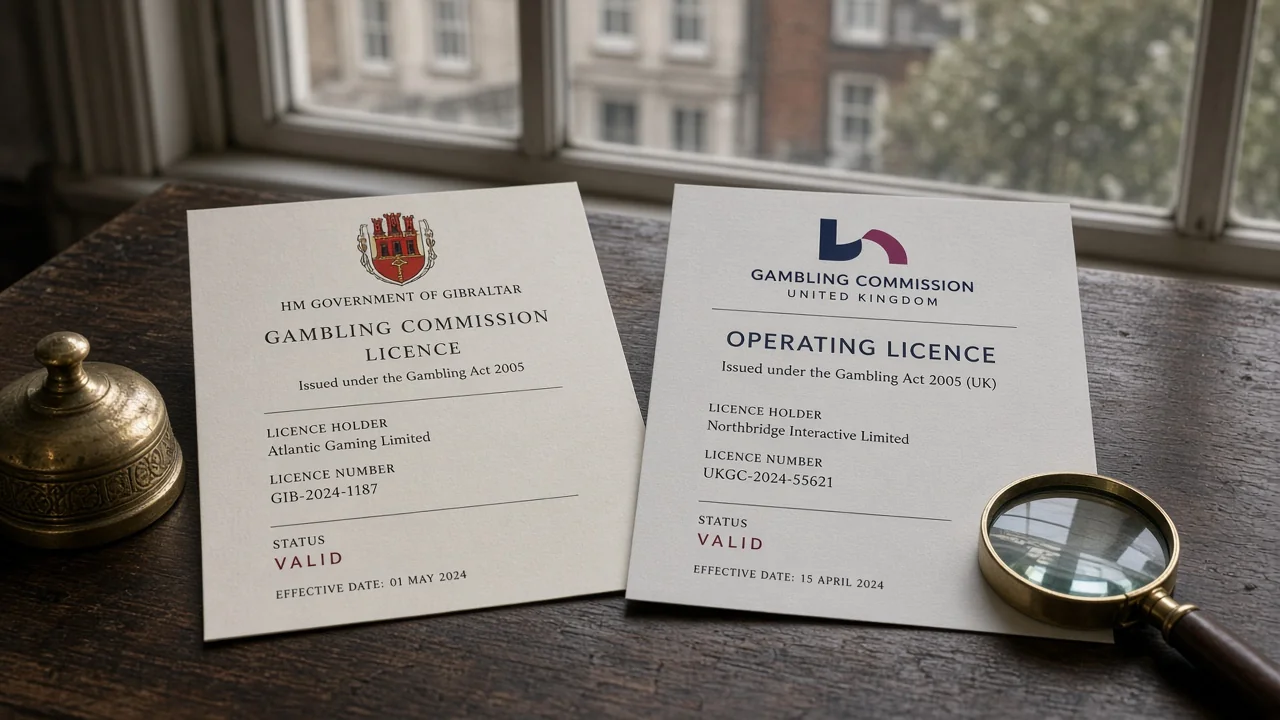
- White label — the licence covers a white label arrangement, where a licensed operator provides the platform and licence under which another brand trades. The brand you see may look independent, but the legal responsibility sits with the licence holder named in the register.

The white label category is where branding misleads most often. A site can look like a small, distinctive operator and in fact sit under a large licence holder you have never heard of. That is not automatically a problem — but it changes who you are trusting with your money, and it is the register, not the website, that tells you who that is.
What a UKGC licence commits the operator to
Checking the licence is not a bureaucratic ritual; it identifies a company bound by specific obligations. A UKGC-licensed casino must hold player funds in separate, segregated accounts, kept apart from the operator’s own working capital. Even so, segregation is not the same as a guarantee: player funds can be classified as not protected, medium protection, or high protection, and only high protection — which involves holding player funds in independent trust accounts — guarantees your balance if the operator becomes insolvent. The protection level is something you can and should check alongside the licence itself.
Fund Protection Levels
UKGC-licensed casinos categorise player funds into three levels of protection:
- Not protected: No specific guarantee beyond standard segregation.
- Medium protection: Offers some safeguards, but not a full guarantee.
- High protection: The highest level, involving holding funds in independent trust accounts to guarantee your balance if the operator becomes insolvent.
The licence also obliges the operator to submit to regular independent audits of game fairness by agencies such as eCOGRA, iTech Labs, TST and GLI. When you verify a licence, you are confirming that the company behind the casino is subject to these checks — not just claiming to be fair in its marketing copy.
Common mistakes when checking a licence
- Judging by appearance. Professional design, well-known game providers and a live chat window prove nothing about licensing. Offshore sites can buy all three.
- Trusting a logo without clicking through. A licence badge is only meaningful if it leads to the official register and the entry matches. Anyone can paste a regulator’s logo onto a page.
- Confusing the brand with the operator. Searching the register for the casino’s marketing name when the licence sits under a different company name will return nothing — search for the legal entity named in the footer.
- Ignoring the domain check. A licence covering one domain does not cover a sister site with a different address unless the register says so.
The habit worth forming
Before your first deposit at any casino, open the UKGC register in a second tab and confirm three things: the operator is listed, the licence is active, and the domain matches. It takes less time than reading a single bonus terms page — and unlike the bonus, it tells you what happens to your money if something goes wrong.
Licensed Casino Sites and White-Label Operations
Two casinos can look completely different — different logos, different colour schemes, different game lobbies — and still be run by the same legal entity. The reverse is also true: two sites that look almost identical can belong to entirely separate operators with separate licences. If you judge safety by what a site looks like, you are judging the packaging. The substance sits elsewhere, in the register entry of the company that actually holds the licence.
What a white-label casino actually is
A white-label operation is a casino brand built on someone else’s infrastructure and licence. A company that already holds a UK Gambling Commission (UKGC) licence offers its platform, payment processing and compliance machinery to partners, who then launch sites under their own consumer-facing names. The name you see in the browser tab is a brand; the entity legally responsible for your account is the licence holder behind it.

This is not a loophole or a mark of a dodgy site. The UKGC public register explicitly includes white-label licences alongside active and inactive ones, so the arrangement is a recognised, regulated structure rather than a workaround. It is also common at the reputable end of the market, precisely because it lets a new brand inherit an established operator’s compliance obligations instead of building them from scratch.
What it means for you is practical: the brand name tells you nothing on its own. The register entry does.
Why the operator matters more than the name
When a white-label site is connected to Gamstop, when its terms and conditions spell out bonuses, withdrawal policies and verification requirements, and when its games carry independent fairness certification, that is not the brand delivering those things — it is the licensed operator, because those are obligations attached to the licence, not to the logo. If the operator fails to meet them, it is the operator the UKGC acts against, regardless of how many consumer-facing brands sit on top.
White-Label Operations
A white-label brand uses a licensed operator’s platform and licence. While the brand name may be new, the legal accountability and regulatory obligations lie with the underlying licence holder named in the UKGC register.
This cuts both ways. A site you have never heard of can be perfectly safe because it runs on a well-regulated operator’s licence. And a site with a familiar, polished brand can still leave you with a complaint that has to be resolved through the operator behind it — which is why identifying that operator before you register is worth the few minutes it takes.
What the licence attaches to the games
A licensed operator’s responsibilities extend to the games themselves, not just the banking. Games at UKGC-licensed casinos must use Random Number Generators (RNGs), and those RNGs must be tested for randomness by independent agencies. Operators undergo regular independent audits of game fairness by bodies such as eCOGRA, iTech Labs, TST and GLI.
The connection to white labels matters here. If you play the same slot on two different brands that share an operator, you are playing the same tested game on the same audited platform. If you play it on two brands with different operators, each operator carries its own audit trail for that game. The fairness certificate belongs to the game and the licence holder, not to the colour of the site serving it to you. Safe slot sites and safe live casino products are, in this sense, a property of the operator’s compliance — which is why reviews that compare brands without naming the operator behind them are comparing window displays.
Complaints follow the operator too
If something goes wrong — a disputed withdrawal, a bonus applied incorrectly, a verification demand you think is excessive — your complaint goes to the operator. UKGC-licensed casinos must provide access to Alternative Dispute Resolution (ADR) services, so if the operator’s own response does not settle the matter, an independent ADR body reviews it. Here again, the consumer-facing name is not the defendant: the entity on the register is. A white-label brand cannot quietly distance itself from a dispute by pointing at its platform provider, because legally there is no distance — the licence holder is accountable.
The short version
A safe gambling site in the UK is not a name you recognise; it is a brand attached to a licence entry you can find. Licensed casino sites and white-label operations are held to the same standard by the same mechanism — one company, one licence, one set of obligations, however many storefronts it chooses to run. Check who holds the licence, and the branding becomes what it should have been all along: a matter of taste, not of trust.
Safe Online Casinos for Real-Money Play
Moving from reading about a casino to putting actual money into it changes what safety means. A well-designed site and a generous welcome bonus tell you nothing about what happens to your money after you deposit it. At a UKGC-licensed casino, the safeguards that matter are the ones you mostly never see: identity checks, the legal treatment of your balance, and what happens if the operator itself runs into trouble.
Your money is kept separate — but that is not the same as protected
Every UKGC-licensed casino must hold player funds in segregated accounts, separate from the money the operator uses to run its business. This is the baseline requirement, and it exists for a simple reason: if a casino mixes player balances into its own accounts, those balances become ordinary company cash that creditors can claim when things go wrong.
Segregation alone, however, does not tell you how safe your funds are if the operator becomes insolvent. Player funds at UKGC-licensed casinos fall into one of three categories: not protected, medium protection, or high protection. Only high protection guarantees your funds if the operator fails, and it works by holding player money in independent trust accounts — legally separate from the operator’s own assets. A casino with medium protection offers some safeguards, but not a guarantee; a casino with no fund protection offers you the segregated account and nothing more.
Critical Distinction
Attention Segregated accounts ensure player money is kept separate from business capital, but they do not guarantee your funds if the operator fails unless the casino provides high protection via independent trust accounts.
The category a casino falls into is not advertising material, so you will not find it in a banner next to the bonus offer. It sits in the casino’s terms, and the difference between the categories is exactly the difference between getting your balance back and standing in line with other creditors. Before you deposit a meaningful amount, it is worth knowing which category applies.
KYC checks happen before you can gamble
UKGC-licensed casinos must verify your age and identity through KYC (Know Your Customer) checks before allowing you to gamble. This is not a formality that happens after you have already deposited and played — the licence conditions require the checks up front, which is why you will be asked for documents such as proof of identity and address when you register.
The checks do not necessarily end there. According to one UK casino review site, players may be asked for additional documents later if their gambling activity triggers further verification checks. This can be inconvenient, especially when a withdrawal is waiting on it, but it is a structural part of how a licensed casino operates rather than a sign that something has gone wrong with your account. An operator that never asked for documents would be the one failing its licence conditions.
What "safe" does and does not cover
It helps to be precise about what these safeguards actually give you at a real-money casino:
- Guaranteed: your funds sit in segregated accounts, identity checks screen out underage and fraudulent accounts, and games are subject to independent fairness testing.
- Conditional: recovery of your balance if the operator fails depends on the fund-protection category — only high protection, via independent trust accounts, guarantees it.
- Not covered: any promise that you will win. Safety at a licensed casino means the game is fair and your money is accounted for, not that the outcome favours you.
This distinction matters for how you approach the money itself. A safe casino transaction — deposit or withdrawal — is one that happens on a licensed platform with your funds correctly segregated; it is not a transaction that carries less financial risk as gambling. The only control that reliably limits your financial exposure is the one you set yourself: deposit limits, loss limits and session limits, which UKGC-licensed casinos are required to offer, alongside Gamstop self-exclusion if you want to block access to all licensed gambling sites for a period of between six months and five years.
The uncomfortable part
The inconvenient truth about fund protection is that most players never check it, because it only becomes relevant on the day it is too late to do anything about it. Insolvency at a UKGC-licensed casino is rare, but "rare" and "never" are different words, and the difference between them is measured in whatever happens to be sitting in your account balance. Checking a casino’s fund-protection category takes minutes; recovering funds from a failed operator without high protection can take considerably longer, if it happens at all.
Real-money play at a UKGC-licensed casino is, structurally, one of the better-protected forms of online gambling available to UK players. The framework exists, the checks are enforced, and the failure routes are understood. What the framework cannot do is decide how much of your money belongs on the table — that part has always been, and remains, entirely yours.
How to Choose a Safe and Reliable Online Casino
Knowing what makes a casino safe is one thing. Deciding whether a specific site deserves your registration is another. The difference comes down to what you can verify before you hand over any personal details — and most of it takes a few minutes of reading.
Verification Checklist
- Confirm the operator is listed on the UKGC public register
- Ensure the licence status is currently ‘Active’
- Verify the website domain matches the register entry
- Check that the terms and conditions are transparent and readable
Step 1: Confirm the operator’s licence
Start with the licence, and start with the operator rather than the brand. A casino’s homepage can look polished while the company behind it holds no UK Gambling Commission (UKGC) licence at all — or holds one under a name you would never have guessed. Cross-check the licence number against the UKGC’s public register and confirm the domain listed there matches the site you’re on. If the register entry is missing or the domain doesn’t match, stop there. No bonus or game library compensates for an unlicensed operator.
Step 2: Read the terms you’ll actually be bound by
UKGC-licensed casinos must offer transparent terms and conditions, with clear information on bonuses, withdrawal policies and verification requirements. That obligation exists on paper; your job is to check whether the reality reads clearly. Before registering, look for:
- Bonus conditions — what the wagering requirements are, which games contribute, and what happens to the bonus if you withdraw early.
- Withdrawal policy — whether withdrawal limits, processing times and any identity checks are stated plainly or buried in vague wording.
- Verification requirements — which documents the casino asks for and at what stage.
Vague language in these sections isn’t just a style problem. A casino that can’t state when you’ll get your money is telling you something, just not directly.
Step 3: Check the responsible gambling tools before you need them
This is the check most players skip, and it’s the one that says the most about how a casino treats its customers. UKGC-licensed casinos must provide tools for responsible gambling, including deposit limits, session limits, loss limits and self-exclusion options. Before registering, open the responsible gambling page and confirm these controls are actually there — not mentioned in passing in the footer, but described with instructions you can follow.
Look for Gamstop participation too. A UKGC-licensed casino must be part of the Gamstop self-exclusion system, so if a site advertises itself as a way around Gamstop, it has told you everything you need to know: it is not operating within the UK framework.
Safe Gaming
Using responsible gambling tools like deposit and loss limits is a sign of a compliant operator and is the most effective way to maintain control over your play.
Step 4: Expect KYC — and treat it as a good sign
UKGC-licensed casinos must verify players’ age and identity through KYC checks before allowing gambling. A casino that lets you deposit and play without any verification is not doing you a favour; it’s operating outside the rules that protect you. The same applies further down the line: according to one operator review, players may be asked for additional documents if their gambling activity triggers further verification checks. Treat this as part of the system working, not as an excuse to move to a site that asks nothing.
Step 5: Weigh what you’ve found
By this point you have a short checklist, and each item is pass or fail:
- Licence confirmed against the register, with a matching domain.
- Bonus, withdrawal and verification terms written clearly.
- Responsible gambling tools present and explained.
- KYC applied at registration, not quietly skipped.
A casino that passes all four hasn’t earned your trust forever — but it has earned a registration. A casino that fails any one of them has saved you the trouble. The safest decision you’ll make is the one where you walk away before creating the account, and unlike most safeguards in gambling, this one is entirely under your control.
Finding a Legitimate Casino Bonus Without Missing the Conditions
A bonus headline is marketing. The conditions attached to it are the part that decides whether the offer is worth anything at all. At a UKGC casino, bonuses and sign-up perks must come with transparent terms — clear information on bonuses, withdrawal policies and verification requirements is a licensing obligation, not a courtesy. So the right question is never "how big is this bonus?" but "what do I have to do before I can withdraw anything connected to it?"
Where to look before you accept
Three documents matter more than the banner on the homepage:
- Bonus terms. The full rules, not the summary. This is where the actual requirements live.
- Withdrawal policy. Some offers tie your deposit to bonus conditions — you may not be able to withdraw your own money until the conditions are met.
- Verification requirements. If identity checks are triggered while a bonus is active, the timeline for getting your funds out can change.
If any of these are vague, hard to find, or answer a different question than the one you asked, treat that as information about the operator, not a formatting quirk.
Wagering requirements, and the UK cap
The core condition is the wagering requirement: how many times you must play through bonus funds before they convert to withdrawable cash. A higher multiplier means more betting before you see any return, and a greater chance of losing the bonus entirely along the way.
This is also where the UK market differs from much of the rest of the world. According to a specialist casino review, the UKGC has capped wagering requirements for UK casino bonuses at 10x. Operators are not free to impose the eye-watering multiples that appear on unregulated sites targeting other countries. That cap is one of the more practical reasons to stay with a UKGC-licensed operator: the worst-case terms are bounded by rule, not by the operator’s imagination.
It also gives you a benchmark. The same specialist review coverage treats wagering requirements of 10x or lower as preferable for fair casino bonuses — meaning the best you can realistically hope for at a licensed site is at the level of the cap itself. If an offer advertises "no wagering," read the terms anyway: no-wagering bonuses typically come with a smaller bonus amount or restrictions on which games qualify. The maths has to balance somewhere.
Red flags in the small print
Beyond wagering, check for:
- Game restrictions. Whether slots, table games or live games count towards the requirement, and at what weighting.
- Time limits. How long you have to meet the conditions before the bonus and any winnings from it expire.
- Maximum withdrawal caps on bonus winnings. A limit on what you can take out, regardless of what you win.
None of these details make a bonus illegitimate. Hiding them, or stating them in a way that requires effort to decode, is what separates a legitimate offer from one designed to be missed.
A safe bonus at a safe casino is not the largest one — it is the one whose conditions you have read, understood and could still accept if everything went wrong. The licence guarantees that the rules exist and are visible; it does not guarantee they are generous. That part remains your job.
Secure Casino Payments, Including Crypto Questions
When you hand money to a casino, the security question has two layers: whether the payment method itself is handled correctly, and whether the operator is accountable to a regulator if something goes wrong. The second layer matters more, and it is the one people most often skip when a site advertises "crypto payments" or "instant banking" as a badge of trust.

What card payments are actually permitted
In the UK, credit card gambling is prohibited. You cannot fund a casino account with a credit card, full stop. What you can use are debit cards — Visa Debit and Mastercard-issued debit cards are allowed. If a casino accepts your credit card, it is either operating outside the UKGC framework or breaking the rules that framework imposes. Either way, that tells you something more useful than any payment badge on the homepage.
Deposits via debit cards and e-wallets are typically instant at UKGC-licensed casinos, so there is no practical reason to accept a slower or less transparent deposit route in exchange for a promise of extra convenience.
What secure handling looks like
A casino that processes payments properly does a few unglamorous things. It encrypts the connection between your browser and its servers, so card and account details are not exposed in transit. It verifies who you are before letting you gamble — age and identity checks are a licensing requirement, not an optional courtesy. And it publishes withdrawal policies that state the method-specific timelines in advance: debit card and bank transfer withdrawals typically take one to five business days. A site that hides or frequently changes those terms after you have deposited is telling you how it treats the money once it holds it.
UK Payment Rules
In the United Kingdom, gambling with credit cards is prohibited. Legitimate licensed operators will only allow deposits via debit cards or other approved methods like e-wallets.
The details of comparing specific deposit and withdrawal methods — e-wallets, bank transfers, prepaid cards — are covered separately. The point here is the standard any method should meet before you use it.
The crypto question
Searches for a safe crypto casino UK keep growing, and the honest answer is short: UKGC licensing remains the essential check, and it sits awkwardly with most crypto offers.
A casino that takes Bitcoin or other cryptocurrencies is not automatically unsafe. But crypto payments are frequently promoted by sites that operate without a UK licence precisely because the payment route sits outside the regulated banking system — no card issuer, no chargeback mechanism, no debit-card ban to comply with. The same features that appeal to the operator appeal to someone who would rather not be answerable to a regulator.
That is the practical test. If a crypto-accepting site holds a UKGC licence, you can verify it against the public register like any other operator, and the usual protections apply. If it doesn’t, then "crypto" is not adding security — it is removing the structures that make secure casino payments UK players rely on possible in the first place: regulated transaction handling, identity checks, and a complaints route that ends somewhere other than the operator’s own inbox.
So treat any crypto claim as a question, not an answer. The question is always the same one: who is the operator, and can you find them in the UKGC register? If you can, the currency is a detail. If you can’t, no payment technology fixes that.
Safe Casino Games and Online Slots
When players talk about safe casino games, they usually mean two different things at once: whether the game is fair by design, and whether the site offering it is licensed. The licensing side is covered elsewhere in this guide. This section deals with the games themselves — what makes a slot or table game safe to play, and how you can tell the difference between a genuinely audited game and a marketing claim.

How game fairness is actually verified
Every casino game at a UKGC-licensed site must use a Random Number Generator (RNG) — the software that produces each spin, card deal or dice roll without any predictable pattern. An RNG doesn’t guarantee you’ll win; it guarantees the outcome isn’t rigged in advance or adjusted in response to your play.
The important part is who checks it. UKGC-licensed casinos must undergo regular independent audits of game fairness by agencies such as eCOGRA, iTech Labs, TST and GLI. These bodies test that the RNG behaves randomly and that the game’s published mechanics match its actual behaviour. A game that has passed this kind of testing is a game whose maths has been inspected by someone with no stake in your losses.
What this means for online slots
Slots are where fairness questions come up most, partly because they’re the most heavily advertised and partly because promotional copy often blurs the line between a verified game and a promised win. An audited slot is safe in the sense that its outcomes are random and its stated Return-to-player (RTP) reflects what the game is built to return over time. No audit makes a slot profitable, and no provider can honestly claim otherwise. If a promotional message implies a game is "easy to win" or "guaranteed to pay", that claim has nothing to do with fairness testing — treat it as advertising, not information.
Fair games, safe play
Even on a fully audited game, the protection around your play comes from responsible gambling tools: deposit limits, session limits, loss limits and self-exclusion options that UKGC-licensed casinos must provide. A fair RNG determines individual outcomes; these tools determine your overall exposure. You need both, and only one of them is tested by an independent agency.
Safe Deposit Methods and Casino Withdrawals
Once you have confirmed a casino holds a UK Gambling Commission (UKGC) licence, the payment question becomes practical rather than legal: which routes get money in and out, how fast, and with what catches.
Withdrawal Timelines
First, the casino must verify your identity and review your withdrawal request.
Depending on your method, the funds are released. E-wallets (PayPal, Skrill) take minutes to 24 hours, while debit cards take 1 to 5 business days.
For bank transfers, the funds move through the banking system, typically taking 3 to 5 business days to reach your account.
Deposits
Debit cards remain the default option. Credit card gambling is banned in the UK, but Visa Debit and Mastercard debit cards are accepted, and deposits made this way — like e-wallet deposits — are typically instant at UKGC-licensed casinos. The card is issued in your own name, which keeps verification simple later.
E-wallets such as PayPal, Skrill and Neteller also deposit instantly, though some operators exclude e-wallet deposits from certain bonuses and sign-up perks, so check the terms before choosing a method.
PaysafeCard works differently: it is a prepaid voucher, not an account, so it suits players who want to deposit without linking a bank card. The trade-off is twofold. It supports deposits only — withdrawals must go through another method. And the limits are tight: a payment-method review of UK casino options reports a £40 spending cap for unregistered users, rising to £1,000 for registered ones. For anything beyond small deposits, it stops being practical.
Withdrawals
This is where methods genuinely differ, and where the fine print earns its keep.
| Method | Time after approval |
|---|---|
| PayPal | Within 0–24 hours |
| Skrill / Neteller | 15 minutes to 24 hours |
| Debit card | 1 to 5 business days |
| Bank transfer | 3 to 5 business days |
Two things to note from that table. First, e-wallets are the fast lane: if you use PayPal, Skrill or Neteller, the wait is measured in hours, not days. Second, the times quoted are after approval — the casino’s own verification and review stage sits in front of them and can add to the total. Debit card and bank transfer withdrawals take longer because they pass through the banking system; there is no way around that at any licensed operator.
Google Pay
Google Pay does not support online casino withdrawals in the UK at the time of writing, according to a payment-method comparison site. You can sometimes use it to deposit, but plan on a different route — debit card, e-wallet or bank transfer — to get winnings back out.
The practical takeaway
Match your deposit method to your withdrawal needs before you start. If you expect to withdraw, an e-wallet or debit card keeps everything on one track; PaysafeCard deposits always require a second method for cashing out. And whatever you choose, remember that a UKGC casino is required to state its withdrawal policies clearly in its terms — vague payment terms are a warning sign, not a formatting quirk.
Safe Casino Apps: What to Check Before Installing
A casino app is not a separate business — it is one of several doors into the same operator. That means the safety checks you would run on a desktop site apply unchanged to the app on your phone, and a well-designed icon proves nothing.
Start with the operator, not the app
Before installing anything, confirm which company stands behind the app. A UKGC casino that offers an app will list the licensed operator in its store description and inside the app itself, and you can match that name against the UK Gambling Commission’s public register exactly as you would for a website. If the register entry does not cover the domain or platform the app connects to, that is a reason to stop, not to investigate further.
Be equally careful about where you install from. Apps distributed outside the official app stores sidestep the store’s own review process, and unofficial copies of well-known casino brands exist. When in doubt, use the download link on the operator’s own site rather than a search result.
Responsible gambling tools must survive the move to mobile
A licensed operator cannot shed its obligations because you switched devices. Check that the app gives you the same responsible gambling tools as the desktop version: deposit limits, loss limits, session limits and reality checks should be reachable in the app’s settings, not buried behind a redirect to the website.
The most important of these is Gamstop. Every UKGC casino is part of the GamStop self-exclusion system, which blocks you from all licensed gambling sites and apps for a chosen period of between six months and five years. Because the block works across every licensed operator, it applies to their apps too — if a casino app lets a Gamstop-registered player back in, it is operating outside the licensing system entirely.
Convenience is not the safety test
Fast logins, saved payment details and fingerprint access make an app pleasant to use, and none of them make it safe. The licence check and the availability of self-exclusion and limit tools take a few minutes; the app store rating takes none of that risk away.
What is a gambling licence, and why do you need one?
A gambling licence is the legal authorisation that allows an operator to offer casino games in Great Britain. A UKGC licence requires protections such as responsible gambling tools, transparent terms, identity checks and access to ADR for complaints.
How can I ensure I’m gambling responsibly?
Set deposit, session and loss limits before you start playing, and use self-exclusion if needed. UKGC-licensed casinos must provide these tools, and GamStop can block access to all licensed gambling sites for a chosen period.
Does the ban cover Visa and Mastercard?
The UK gambling credit-card ban covers credit cards, while Visa Debit and Mastercard-issued debit cards can still be used. Prepaid cards such as PaysafeCard also support deposits, but not withdrawals.
Created by the ”Casinouk Game Info” editorial team.