
Non-UK Licence Casino: What British Players Should Know
 Available in GB
Understand what changes outside UKGC regulation, from player protections and dispute handling to payments, verification and game choice.

Table of Contents
- What a Non-UK Licence Means for British Players
- How Casino Licences Shape the Online Experience
- UKGC Casinos and the Protections You Give Up Elsewhere
- Licensed Online Casinos: What to Check Before You Sign Up
- Payment Methods and Flexibility Beyond the UK
- The Wider Game Selection at Overseas Casinos
- Registration, KYC and Withdrawals: Where Speed Has a Cost
- Why Some Players Switch to Non-UK Casino Sites
- Curaçao and Crypto Casinos: Flexibility Versus Oversight
- MGA-Licensed Casinos and the Meaning of a Malta Licence
- Non-UKGC Sites: How to Compare the Licence Behind the Logo
- How to Choose a Reputable Licensed Casino Without Guesswork
What a Non-UK Licence Means for British Players
A non-UK licensed casino is a gambling site that holds its operating licence from a regulatory body outside the United Kingdom. Common licensing jurisdictions include Malta, Gibraltar, Curaçao and Cyprus, and a newer name appearing on more casino footers is Anjouan, whose gaming authority issues and supervises internet gaming licences under Anjouan law. Whatever the jurisdiction, the defining feature is the same: these casinos are not regulated by the UK Gambling Commission and do not follow its rules.
That single sentence carries more weight than it might seem, because the licence determines almost everything about how a casino behaves toward you — what it must check before you play, what it must do when something goes wrong, and who you can turn to if it doesn’t.
What the licence changes in practice
Under the Gambling Act 2005, any operator offering online gambling to consumers in Great Britain must hold a UKGC licence. This is why the casino landscape splits into two groups:
- UKGC-licensed casinos, which must comply with British rules on advertising, fairness, self-exclusion and dispute handling.
- Non-UK licensed casinos, which answer to their own licensing authority instead — whether that is the Malta Gaming Authority, the Gibraltar regulator, or a more distant jurisdiction with lighter requirements.
This page provides a concise reference for reviewing casino operators relevant to the non-UK licence casino 2026 topic. Use the key licence, bonus, payout-speed and minimum-deposit details to identify the options that match your preferences.
License: UKGC Operator Licence · Bonus: £200 welcome bonus · Payout speed: Within 48 hours · Min. deposit: £10 32Red holds a UKGC Operator Licence and offers a £200 welcome bonus. Its minimum deposit is £10, with payouts stated as being completed within 48 hours.
License: UKGC Operator Licence · Bonus: £100 bonus · Payout speed: Within 24 hours · Min. deposit: £10 ProgressPlay Limited is listed with a UKGC Operator Licence and a £100 bonus. It accepts deposits from £10 and states that payouts are made within 24 hours.
License: UKGC Operator Licence · Bonus: £20 bonus · Payout speed: Within 48 hours · Min. deposit: £10 Silverbond Enterprises holds a UKGC Operator Licence and offers a £20 bonus. The minimum deposit is £10, while payouts are stated to arrive within 48 hours.
License: UKGC Operator Licence · Bonus: £100 bonus · Payout speed: Within 24 hours · Min. deposit: £10 Genesis Global Limited is listed with a UKGC Operator Licence and a £100 bonus. It has a £10 minimum deposit and states that payouts are completed within 24 hours.
License: UKGC Operator Licence · Bonus: £100 bonus · Payout speed: Within 24 hours · Min. deposit: £10 LeoVegas holds a UKGC Operator Licence and offers a £100 bonus. Its minimum deposit is £10, with payouts stated as being completed within 24 hours.
License: UKGC Operator Licence · Bonus: £50 bonus · Payout speed: Within 48 hours · Min. deposit: £10 Platinum Gaming Limited is listed with a UKGC Operator Licence and a £50 bonus. It accepts deposits from £10 and states that payouts are made within 48 hours.
The gap between those two groups is not fixed. Regulatory oversight varies significantly between jurisdictions: some authorities, such as those in Malta and Gibraltar, maintain rigorous standards, while others impose far less stringent rules on their licensees. A licence badge at the bottom of a homepage therefore tells you very little on its own; the jurisdiction behind that badge tells you considerably more.
The same applies to Anjouan-licensed casinos. Anjouan Gaming issues internet gaming licences in both business-to-consumer and business-to-business categories, supervises its licensees, and has the power to suspend or revoke a licence — one licence has already been suspended pending investigation. That is a real regulatory function, but it is a function exercised under Anjouan law, not British law, and the difference matters when your money is the thing in question.
Is it legal for a UK resident to play?
Current regulations do not prohibit UK residents from using overseas gambling websites. You are not breaking the law by opening an account with a casino licensed in Malta or Curaçao. What you are doing is stepping outside the framework that the UK Gambling Commission built for your protection — and that framework does not follow you out.
Concretely, the consumer protections and dispute resolution processes available to UK players may not apply to a non-UK licensed casino, because of its jurisdictional independence. If a dispute arises, your route runs through the casino’s own licensing body or its internal complaints process, not through any British authority. Some regulators handle such complaints well; others make the process hard to reach from the UK at all.
This is the honest starting point for the rest of this guide: a non-UK licensed casino can be a legitimate, professionally run business, and many are licensed by authorities with rigorous standards. But "licensed" and "licensed to the standard you are used to" are two different claims, and they deserve two different levels of trust.

The sections that follow look at what a casino licence actually covers, what the UK Gambling Commission specifically requires that you would give up, and — most importantly — how to check the licence behind the logo before you hand over a deposit. The aim is not to steer you toward or away from overseas sites, but to make sure that whatever you choose, you choose it with your eyes open.
How Casino Licences Shape the Online Experience
A casino licence is not a badge or a logo in the footer of a website. It is a legal authorisation, granted by a regulator, that allows a company to offer gambling to customers, and it comes with obligations the operator must keep meeting for as long as it holds that authorisation. What those obligations are — and how strictly they are enforced — depends almost entirely on who issued the licence in the first place.
What a licence actually covers
Licensing regimes generally rest on the same pillars, even when the details differ:
- Who runs the business. Regulators vet the identity, ownership and finances of the people behind an operator before granting a licence, and continue to supervise them afterwards.
- How the games behave. A licence typically carries requirements around game fairness — certified random number generators, tested payout mechanics and honest advertising of what a game does.
- How player money is treated. Many regimes require customer funds to be separated from the operator’s working capital, so a business failure does not automatically swallow player balances.
- How complaints are handled. Licensed operators are expected to have a formal dispute process, and the regulator itself is usually the final point of escalation.
- Who is kept out. Age verification, self-exclusion tools and problem-gambling safeguards are standard obligations, though their depth varies by jurisdiction.
None of this makes an operator honest. What it does is create consequences for dishonesty: a regulator with real powers can fine, suspend or strip a licence, which is precisely why the identity of that regulator matters more than the fact that a licence exists.
Why the issuing jurisdiction matters
Not all licences carry the same weight. Regulatory oversight varies significantly between jurisdictions. Authorities such as the Malta Gaming Authority and the Gibraltar regulator maintain rigorous standards — demanding auditing, strict operational requirements and accessible complaint channels. Other jurisdictions apply far less stringent rules, with lighter vetting, weaker enforcement and dispute processes that are, in practice, difficult for a foreign player to reach.
The practical consequence for a British player is this: if something goes wrong at an overseas site, the UK Gambling Commission cannot help you. Dispute resolution at non-UK licensed casinos relies on the casino’s own licensing body or its internal complaint process, and the accessibility of those routes varies. Consumer protections and dispute procedures available to UK players do not extend to non-UK licensed casinos, precisely because those casinos sit outside the UK regulatory framework.
Maintains rigorous standards with auditing and accessible complaint channels.
Regulated authority with strict operational requirements.
Issues and supervises internet gaming licences under Anjouan law.
This is why a licence should be judged, not counted. A casino licensed by a demanding regulator is making a verifiable commitment. A casino licensed somewhere with minimal supervision holds a document that says little more than that a fee was paid.
A working example: Anjouan
The island of Anjouan illustrates how a licensing regime is built and what it does. Anjouan Gaming is the designated regulatory authority for licensing and supervising internet gaming operations under Anjouan law. It issues, supervises and enforces Internet Gaming Licences within its jurisdiction, in both B2C categories (operators serving players directly) and B2B categories (suppliers serving other gambling businesses). It also holds real enforcement power: it can suspend or revoke licences, and it has exercised that authority — at least one Internet Gaming Licence has been suspended by Anjouan Gaming pending investigation.
Whether Anjouan’s standards match those of longer-established European regulators is a separate question, and one each player has to weigh for themselves. What the example shows is the anatomy of a licensing system: a named authority, defined licence categories, supervision and the demonstrated willingness to act. When you encounter an unfamiliar regulator, those four elements — name, categories, supervision, enforcement — are the minimum you should be able to confirm before trusting it.
Licences as a comparison framework
Once you understand what a licence is supposed to do, comparing operators becomes more systematic. Rather than asking "is this casino licensed?", ask a chain of more precise questions:
- Which authority issued the licence? The jurisdiction determines the standards the operator was held to and who supervises it now.
- Is the licence current? Licences can lapse or be suspended. A logo on a website proves nothing about today’s status.
- What can the regulator actually do? Some can freeze operations, order refunds and revoke licences; others offer little beyond a certificate.
- Where would a dispute go? If the operator ignores you, is there a regulator — or any external body — you can realistically turn to?
The same framework applies to a new licensed online casino and to an established one. Age is not the test; the licence behind the name is.
What a licence does not do
It is worth being clear about the limits. A licence does not vouch for bonus terms, withdrawal speeds or customer service quality — those vary from operator to operator regardless of regulator. It does not make a casino generous, and it does not make it a good choice for you personally. And critically, a licence from any jurisdiction — however rigorous — is not equivalent to a UK licence, because the protections that attach to UK regulation simply do not travel.
What a licence gives you is a floor, not a ceiling: a minimum standard of conduct with an enforcement mechanism behind it. The higher that floor and the stronger the enforcement, the more the licence is worth. The next section looks at what UK regulation specifically provides — and what you step away from when you play at a casino that holds its licence elsewhere.
UKGC Casinos and the Protections You Give Up Elsewhere
When you play at a casino licensed by the UK Gambling Commission, you are playing inside a system that was built, slowly and somewhat reluctantly, around one idea: the operator must answer to someone. The Commission was established under the Gambling Act 2005 and took on its full powers in 2007, and it does not simply issue a certificate and disappear. It issues operating, personal and premises licences, keeps a public register of every licence it has granted, and can act against operators who break its rules.
That oversight translates into safeguards you can feel as a player, even if you never think about them.
GamStop Protection
Non-UK licensed casinos are not affiliated with GamStop and do not enforce its self-exclusion programme.
Stake controls. The most visible example is the cap on online slots. According to one dedicated casino review, the UKGC imposes a maximum stake of £2 per spin on online slots. Non-UK licensed casinos, by contrast, generally do not have universal maximum stake limits on games — the rules of whichever jurisdiction issued their licence apply instead, and those rules vary widely. Whether that cap feels like protection or a restriction is your call. What is not in dispute is that it exists in one system and does not exist in the other.
Advertising and bonus rules. The Commission restricts how UKGC-licensed casinos can advertise and structure their promotions. Offshore operators are generally not bound by these restrictions, which is part of why their bonus offers can look larger and their marketing more aggressive. Freedom to offer more is also freedom to promise more than a promotion actually delivers — a point worth holding in mind when comparing headline offers.
Self-exclusion. GamStop is the national self-exclusion scheme covering UKGC-licensed operators. A player registered with GamStop is blocked across licensed sites. Non-UK licensed casinos are not affiliated with GamStop and do not enforce its self-exclusion programme — they are not obligated to. For someone who has excluded themselves for a reason, this is the single most consequential difference between the two systems, and no bonus offer offsets it. If you have registered with GamStop, opening an account elsewhere carries a serious risk of undoing the very decision that scheme exists to support.

Verification before licensing. Before a casino obtains a UKGC operating licence, the Commission assesses the applicant’s identity and ownership, finances, integrity, competence and criminality. Application fees are non-refundable whether or not the licence is granted, and standard processing runs to roughly 16 weeks. This is a slow, expensive filter — which is precisely the point. Not every jurisdiction applies anything comparable before letting an operator go live.
A register you can check. Every current operating licence appears on the Commission’s public register. You can verify a casino by matching the operator name or licence number against that register and confirming the listed domain. This is a check worth running even when you have no doubts — a licence number displayed in a footer means nothing until it matches the register and the domain you are actually playing on.
None of this makes a UKGC-licensed casino automatically fair or a non-UK licensed casino automatically suspect. What it means is simpler: at a UKGC casino, there is a named authority with the power to suspend, fine or revoke, and a documented process behind every licence. Outside that system, the protections listed above do not follow you. Some may be replaced by the rules of another regulator; some may not exist at all. The next section covers how to examine a casino’s credentials in practice — whichever flag its licence happens to fly.
Licensed Online Casinos: What to Check Before You Sign Up
Knowing that a licence matters is the easy part. The harder question is what you should actually look at before you create an account and hand over a deposit — especially when the site you’re considering sits outside the UK regulatory framework. A badge in a website footer is not verification; it’s a claim. Here’s how to examine that claim properly, whether the casino is UK-licensed or based abroad.

Start with the licence itself — and find it yourself
Every legitimately licensed casino displays its licence information, but the display itself proves nothing. What matters is whether you can trace the claim to an independent source.
For UK-licensed operators, this is straightforward. The UK Gambling Commission maintains a public register of current operating and personal licences. You can search by operator name or licence number, and — importantly — confirm that the domain listed in the register matches the site you’re actually visiting. A clone site copying a real operator’s branding won’t survive this check, because the domain won’t match.
For non-UK licensed casinos, the same principle applies but the verification path is different. These sites are not regulated by the UK Gambling Commission and don’t follow its rules, so the UKGC register won’t help you. Instead, you need to identify the licensing authority — Malta, Gibraltar, Curaçao, Cyprus and Anjouan are all common examples — and check whether that authority offers its own public licence register or verification tool. Anjouan Gaming, for instance, is the designated regulatory authority for internet gaming under Anjouan law; it issues, supervises and enforces Internet Gaming Licences in B2C and B2B categories, and it has the authority to suspend or revoke them. A regulator that can actually pull a licence is a regulator worth checking with.
If the licence number isn’t visible anywhere on the site, or the footer only says "licensed" without naming an authority, treat that as a red flag regardless of how polished the rest of the site looks.
Verify the Licence
- Find the licence number and issuing authority in the website footer.
- Check the number against the regulator’s official public register.
- Confirm the domain in the register matches the site you are visiting.
- Verify the regulator has actual power to suspend or revoke licences.
Don’t treat all regulators as interchangeable
Once you’ve identified the issuing authority, the next question is what that authority actually demands from its licensees. Regulatory oversight varies significantly between jurisdictions. Some authorities — Malta and Gibraltar are frequently cited examples — maintain rigorous standards, while others impose less stringent requirements on operators.
The practical consequence for you is dispute handling. If something goes wrong at a UK-licensed casino, there are established escalation routes. At a non-UK licensed casino, dispute resolution relies on the casino’s licensing body or its internal dispute process, and how accessible those routes are to a UK player varies considerably. Consumer protections that exist under UK law may not apply at all, because the operator sits outside that jurisdiction.
So when you compare licensed online casino sites, don’t just ask "does it have a licence?" Ask: which authority issued it, what does that authority require, and what happens if I have a complaint? A licence from a jurisdiction with minimal oversight is better than no licence, but not by much.
Check reputation — but weight it correctly
A new licensed online casino has no track record, and that’s neither good nor bad on its own — every established operator was new once. What you’re looking for is a pattern, not an absence of complaints. Every casino of any size has unhappy customers somewhere; the difference between a legitimate operation and a problematic one is usually visible in what the complaints are about.
Complaints about slow verification or a rejected bonus are common across the industry, including at UK-licensed sites. Complaints about confiscated balances with no explanation, unanswered support channels, or licence numbers that don’t check out against any register are a different category entirely. Look at where the complaints appear, whether the operator responds, and whether the responses address specifics or just repeat marketing language.
One caveat on sources: be aware that many casino review sites are affiliate operations that earn commission when you sign up through their links. A glowing review is not evidence of anything beyond a commercial relationship. Independent player forums, where people argue with each other in public, tend to be more informative.
Read the terms before the terms apply to you
Licence checks tell you about the regulator; the terms and conditions tell you how the operator actually behaves day to day. Before depositing, look at three areas in particular.
Bonus terms. Welcome offers can look generous on the surface while carrying conditions that make them difficult to realise in practice. Check how wagering requirements are described, whether they’re stated at all, and what the withdrawal rules attached to bonus funds are. Terms that are vague on these points are a warning in themselves.
Withdrawal conditions. Find out what documentation is required and at what stage. Some non-UK casinos run less demanding Know Your Customer processes at initial sign-up — at least according to operator reviews of these sites — and then request fuller documentation when you try to withdraw. That sequence isn’t hidden malice; it’s a common compliance model. But it means the first withdrawal is the real test of the site, not the first deposit.
Account and closure terms. Look for clauses about dormant accounts, inactivity fees, and the operator’s right to close accounts. These sections are tedious by design, but they’re where the asymmetries between you and the casino live.
Put the checks together
A licensed casino that passes scrutiny is one where four things line up: the licence is visible and verifiable against the issuing authority’s own records; the regulator has real supervisory powers, including the ability to suspend or revoke; the operator’s reputation shows patterns you can live with, not patterns you can’t; and the terms describe a business you’d be willing to be a customer of. Miss one of these and the other three matter less.
None of this takes especially long — a licence check is a few minutes, terms take longer, and reputation research is ongoing. But it’s time spent before your money is involved, which is the only point at which you have full leverage.
Payment Methods and Flexibility Beyond the UK
One of the most visible differences you notice at non-UK licensed casinos is how you move money in and out. Because these sites sit outside UK Gambling Commission rules, they are not bound by the payment restrictions that shape UKGC-licensed casinos — and that cuts both ways.
Payment Flexibility
Non-UK licensed casinos often support multiple currencies like EUR and USD, along with cryptocurrencies, providing more options than standard UKGC sites.
Deposits, currencies and e-wallets
Non-UK casinos often accept alternative payment methods, including region-specific e-wallets and cryptocurrencies. Where a UK-licensed site typically works in pounds with a familiar shortlist of options, an offshore operator may support multiple currencies at once: euros, US dollars, and cryptocurrencies like Bitcoin. For a player who already holds funds in those currencies, this removes conversion friction. For everyone else, it is simply an extra decision before depositing — and exchange rates and conversion fees are worth checking in the terms rather than assuming.
Withdrawal speed
Withdrawals at non-UK casinos may be processed within hours, and cryptocurrency transactions can be near-instant once the operator releases them. Compare that with the multi-day waits familiar from many UK sites, and the appeal is obvious. The caveat — how documentation checks interact with that speed — belongs to the withdrawal process itself and is covered later in this guide.
The credit card question
Here is the part that deserves more attention than the convenience. Some non-UK casinos accept credit cards for deposits, while credit card gambling is banned at UKGC-licensed casinos. That ban was not arbitrary: gambling with borrowed money is a recognised risk factor for problem gambling, and the UK regulator removed the option deliberately. A site that lets you deposit on credit is not offering you a feature — it is removing a safeguard.
If you do use a credit card at an offshore casino, you are spending money you do not yet have, on a site with no UKGC oversight, potentially in a currency you had to convert. Any one of those alone is manageable. Stacked together, they change the character of the deposit.
The practical takeaway: payment flexibility is real, but treat it as a set of options to evaluate, not a benefit to assume. Check which currencies a site actually supports, what the deposit terms say about card payments, and whether the withdrawal methods match the deposit methods before you fund an account.
The Wider Game Selection at Overseas Casinos
One of the first things British players notice at non-UK licensed casinos is the sheer range of games on offer. Because these sites serve many markets at once, they draw on a global supply of content — and that supply is considerably larger than what a single national market demands.
Niche Table Games and Live-Dealer Formats
The core categories are familiar: slots, roulette, blackjack, baccarat. What differs is the depth around them. Overseas operators often carry niche table games — regional variants of poker, dice games and card formats that rarely appear on UK-facing catalogues, simply because there isn’t enough local demand to justify them.
Live-dealer rooms show the same pattern. Beyond the standard roulette and blackjack tables, international live studios produce game-show formats and specialised tables aimed at specific markets. A casino licensed in Curaçao or Malta and serving players across dozens of countries has a commercial reason to stock them all. A UKGC-licensed operator catering to one market does not.
Smaller Studios and Emerging Providers
Game supply is the other half of the story. The big names most players recognise sit alongside titles from smaller and emerging software studios — developers that haven’t yet secured distribution deals with major UK-facing operators, or that focus on markets where the regulatory route into Britain isn’t worth the cost. The result is a catalogue where the household brands are complemented by games you may not have seen before, sometimes with unusual mechanics or themes that the larger providers don’t attempt.
Where Crypto Fits In
Some of these broader catalogues overlap with crypto-friendly platforms. A Curaçao licensed crypto casino, for instance, may combine a wide international game library with Bitcoin deposits and withdrawals, alongside conventional payment methods. The two features — variety and crypto support — often travel together, because both follow from serving a global rather than national audience.
Variety Is Not a Safety Signal
This is where a note of caution matters. A large game library tells you what a casino offers; it tells you very little about how it is run. Games from smaller studios and live tables from international studios can sit just as easily on a well-supervised site as on a poorly supervised one. The licence behind the operator — and the standards that licence enforces — is a separate question from the size of the lobby.
The same applies to crypto. The fact that a platform accepts Bitcoin doesn’t make it more trustworthy, and a casino advertising itself as a licensed crypto casino with minimal sign-up checks deserves particular scrutiny: a licence that imposes little friction at registration may also impose little obligation on the operator afterwards. The next section looks at exactly that trade-off, where faster onboarding and quicker withdrawals come at the cost of stricter verification arriving later in the process.
Variety vs Quality
A large game library or crypto support indicates market reach, not necessarily regulatory quality.
Broader selection, then, is a genuine feature of the international market — but it is a feature of the supply side, not a certificate of quality. Judge the games catalogue on what it adds, and judge the operator on the checks covered elsewhere in this guide.
Registration, KYC and Withdrawals: Where Speed Has a Cost
The first thing you notice at a casino without a UK licence is how quickly you can start playing. Many non-UK licensed casinos let you open an account with little more than an email address and a password, and some accept a deposit before they have confirmed who you are. Compared with the identity checks a UKGC-licensed casino runs up front, the contrast is stark — and it is not an unmixed blessing.
Why sign-up feels faster
Know Your Customer (KYC) rules exist to prevent money laundering, underage gambling and fraud. UKGC-licensed casinos are required to verify your identity before you can deposit and play freely, which means sending documents — a passport or driving licence, a utility bill, sometimes proof of a payment method — before your first bet is settled.
Non-UK licensed casinos often take a different route. Player reviews of offshore operators repeatedly describe a lighter process at sign-up: a name, a date of birth, a country, and you are in. Some sites run automated checks in the background and only ask for documents if something does not match. The convenience is real, but so is the trade-off — the check you skip at the door will almost always arrive later.
The withdrawal moment
That later moment is the withdrawal. Non-UK casinos commonly allow fast registration with minimal documentation, but a large withdrawal is the point at which the documentation request reappears. If you have won a meaningful sum, expect to be asked for proof of identity, proof of address and proof of funds before the money moves. This is standard anti-fraud practice, not necessarily bad faith, but it is the point where a rushed sign-up turns into a delay.
Processing itself can be quick. Non-UK casinos may process withdrawals within hours, and cryptocurrency transactions can be near-instant. Speed, though, depends entirely on the operator keeping its side of the bargain — which is why the terms matter more than the marketing.
Read the withdrawal terms before you deposit
Before you fund an account at a casino outside UK regulation, look at the withdrawal conditions rather than the headline promises:
- Verification triggers. Check when documents are required — at sign-up, at first withdrawal, or only above a certain amount — and what happens to your funds if you cannot produce them.
- Processing windows. Look for stated turnaround times and whether they are described as targets or guarantees.
- Withdrawal limits and conditions. Some casinos without a UK licence tie withdrawals to bonus playthrough or impose conditions that only surface when you try to cash out.
There is one more cost to weigh. If a withdrawal is delayed or refused, your recourse is the casino’s licensing body or its internal dispute process — not the UK Gambling Commission, which has no authority over operators it does not licence. How accessible that process is varies considerably, and for UK players it can be slow or opaque.
The honest summary: faster onboarding and faster payouts are genuine features of many offshore operators, but they are features you only get to keep if the operator is legitimate. The speed of the front door tells you nothing about what happens at the exit.
Why Some Players Switch to Non-UK Casino Sites
Most British players who look beyond UKGC-licensed casinos are not chasing danger; they are chasing specific features. Understanding what pulls players towards non-UK licensed casinos — and what does not — is worth doing before you form an opinion either way.
Bigger promotions, looser terms
The single most cited reason is the size and structure of bonuses. Non-UK casinos can offer larger welcome bonuses, free spins, and more flexible wagering requirements than UK-licensed casinos, because they are not operating under UK rules on bonus design and advertising. A profile review of these sites reports welcome bonuses with match percentages ranging from 200% to 500% — a range that would look out of place at a UKGC-licensed operator. Some non-UK casinos may also offer lower wagering requirements or no-wagering cashback offers, according to the same category of operator review.
Bonus Types Larger welcome offers and flexible wagering
Stake Limits No universal maximum stake limits on many sites
Self-Exclusion No GamStop affiliation
Treat these figures as reported features, not guarantees. A headline percentage tells you nothing about withdrawal caps, excluded payment methods, or the conditions attached to the offer. Larger promotions are a reason players switch; they are not evidence that the site behind them is trustworthy.
Fewer UK-specific restrictions
The UK Gambling Commission sets a maximum stake of £2 per spin on online slots, and enforces limits on how operators may advertise and structure promotions. Non-UK casinos generally do not have universal maximum stake limits, and they are not bound by UKGC advertising restrictions or self-exclusion guidelines. For some players — particularly those who resent stake caps or who feel the UK rules have grown restrictive — this looser environment is itself the attraction.
It is worth being blunt about the other side: those restrictions exist as player protections. A site without them is not automatically more generous; it is simply less constrained, in ways that can cut both ways.
Payment flexibility
Broader payment support is a third, quieter reason. Non-UK casinos often accept alternative payment methods, including cryptocurrencies and region-specific e-wallets, and may support multiple currencies such as euros, US dollars, and Bitcoin. Some also accept credit cards for deposits — something that is banned at UKGC-licensed casinos. Credit card gambling carries real financial risk, since you are playing on borrowed money, and the UK ban exists for that reason. Flexibility here is not an unqualified benefit.
GamStop and self-exclusion
Non-GamStop casinos are not obligated to block access to players registered with GamStop, because non-UK casino sites are not affiliated with the scheme and do not enforce its self-exclusion programme. For a player who registered with GamStop and now wants back in, this may sound convenient. It is the most serious warning sign on this page: if you self-excluded for a reason, that reason has not gone away. Anyone struggling with gambling should speak to GamCare, BeGambleAware, or Gamblers Anonymous rather than looking for a site that will let them continue.
What switching does not mean
None of the above makes a non-UK licensed casino safer than a UKGC-licensed one. Operators based outside the UK are not regulated by the Gambling Commission, do not follow its rules, and cannot have disputes escalated to it. Consumer protections available to UK players may not apply. The features that attract some players are real, but they sit outside the framework that normally guarantees them — and that trade-off is the actual decision you are making.
Curaçao and Crypto Casinos: Flexibility Versus Oversight
When British players look at non-UK licensed casinos, two models come up again and again: operators licensed in Curaçao and casinos built primarily around cryptocurrency. They overlap heavily — many crypto-friendly sites hold a Curaçao licence — and they share a common selling point: flexibility. That flexibility is real, but it is not the whole picture, and treating the jurisdiction as shorthand for quality is where players get into trouble.
- Verify the exact licence number via the regulator’s official website.
- Read the specific withdrawal terms before making a deposit.
- Check if the regulator has the power to enforce rules.
- Assume a logo in the footer means the site is safe.
- Rely on the size of the game library as a sign of trust.
- Treat all international licences as equal to a UKGC licence.
What these sites typically offer
Curaçao-licensed and crypto-focused casinos sit within the wider group of non-UK licensed casinos, which are often licensed in jurisdictions such as Malta, Gibraltar, Curaçao, or Cyprus. The practical differences from UKGC-licensed casinos show up in three areas:
- Payments. These sites may support multiple currencies — euros, US dollars, and cryptocurrencies like Bitcoin — alongside region-specific e-wallets. For a UK player used to a short list of domestic options, that breadth is the headline attraction.
- Bonuses. Larger promotions and more flexible wagering terms appear frequently at non-UK sites, and crypto casinos in particular have built their marketing around generous welcome packages. “Generous” describes the advertised headline, not the terms attached to it — and those terms are exactly where you should spend your reading time.
- Fewer UK-style restrictions. Without the UKGC’s rules on stakes, bonuses, and advertising, these operators can structure offers and game rules in ways a UK-licensed casino cannot.
Why the licence itself needs checking
Regulatory oversight varies significantly between jurisdictions. Some authorities — Malta and Gibraltar are the usual examples — maintain rigorous standards; others operate with far less stringent rules, and Curaçao has historically sat towards the lighter end of that spectrum. The practical consequence: the jurisdiction printed in a footer tells you the site holds a licence, not that the licence offers meaningful protection if something goes wrong.
So check the specifics rather than the geography:
- Verify the exact licence number against the issuing regulator’s own records, not just the logo displayed on the site.
- Read the withdrawal terms before depositing. Non-UK casinos may process withdrawals within hours, including near-instant cryptocurrency transactions — but the conditions attached to those withdrawals vary widely between operators, and unclear or restrictive policies are a known weakness of the sector.
- Understand what you’re giving up. These sites are not regulated by the UK Gambling Commission, disputes cannot be escalated to it, and non-GamStop obligations mean a site licensed outside the UK is not required to block a player registered with GamStop.
A word on credit cards
Some non-UK casinos accept credit card deposits, which UKGC rules prohibit at licensed sites. If you use one, be clear about what you’re doing: borrowing money to gamble. For anyone with even a hint of difficulty controlling play, that combination is a serious risk, and the absence of UK-based support services makes it harder to pull back.
The honest summary: Curaçao and crypto casinos offer genuine flexibility in payments, promotions, and game variety — and in exchange you carry more of the responsibility for checking who is actually standing behind the operator. The licence behind the logo is the place to start.
MGA-Licensed Casinos and the Meaning of a Malta Licence
When British players start looking at non-UK licensed casinos, one jurisdiction comes up more than any other: Malta. Many of the overseas sites you will encounter hold a licence from the Malta Gaming Authority (MGA), and the name carries enough weight that some operators display it almost as a badge of honour. It is worth understanding what that badge actually means — and what it does not.
Why Malta Dominates Overseas Licensing
Non-UK casinos are often licensed in jurisdictions such as Malta, Gibraltar, Curaçao, or Cyprus. Malta’s prominence comes down to a combination of factors: it is an EU member state, it has built a mature regulatory apparatus specifically for remote gambling, and it has licensed operators for long enough that its processes are well established. Among the jurisdictions that British players encounter, Malta and Gibraltar are generally regarded as maintaining rigorous standards, while some other authorities operate with less stringent rules. That difference matters more than the presence of a licence logo alone.
What an MGA Licence Covers
A Malta licence is not a decorative detail. The MGA supervises its licensees, sets conduct requirements, and expects operators to meet standards around player funds, game fairness, and internal controls. For a British player, the practical significance is this: an MGA-licensed casino sits at the more supervised end of the overseas spectrum, a long way from the lightly governed end where Curaçao-linked and crypto-oriented operators often sit.
What It Does Not Cover
The limits are just as important. An MGA licence does not make a casino UKGC-licensed. The UK Gambling Commission’s rules — stake limits on online slots, credit card restrictions, GamStop enforcement — do not apply to an operator in Malta. If a dispute arises, you cannot escalate it to the UKGC. Dispute resolution for non-UK casinos relies on the casino’s licensing body or its internal complaints process, and how accessible either route is to a UK player varies from site to site. With an MGA licence you at least have a named regulator to approach; whether that route resolves your issue promptly is another question.
A Note on Confusing Licence Terms
While researching, you may run across phrases like "small casino licence" or "large casino licence" in a UK context. These refer to categories of British land-based premises licensing under UK law, not to anything an online player in Britain needs to obtain or check. Similarly, a "casino app licence" is not a separate document: an MGA-licensed operator’s licence covers its app and its site together. If a mobile app claims separate licensing, verify it against the same register check you would apply to the desktop site.
The Honest Summary
A Malta licence signals meaningful oversight by international standards, and it places an operator among the more credible non-UK options. It does not restore the protections you give up by leaving the UKGC framework. Treat the MGA badge as one strong signal in a wider check — not as a promise.
Non-UKGC Sites: How to Compare the Licence Behind the Logo
A licence badge in a casino footer tells you very little on its own. Any operator can paste a regulator’s logo into a website; what matters is whether the licence behind it exists, who issued it, and what that authority can actually do for you if something goes wrong. Since non-UK licensed casinos sit outside the UK Gambling Commission’s system, the comparison work falls entirely on the player.
Can I still use GamStop at offshore casinos?
No, non-UK licensed casinos are not affiliated with GamStop and do not enforce its self-exclusion programme.
Is it illegal for a UK resident to play at these sites?
You are not breaking the law, but you are stepping outside the protection framework built by the UK Gambling Commission.
How can I check if a licence is real?
You should match the operator name and licence number against the issuing authority’s public register and ensure the domain matches.
Start with verification, not the badge
Checking whether an online casino is licensed is not difficult, but it takes a few minutes more than glancing at the footer. Most licensing authorities, including the Malta Gaming Authority, maintain public registers where you can search by operator name or licence number. Cross-reference what you find there with the domain you are actually playing on: the licence should cover that specific site, not a parent company or a sister brand. If the register shows nothing, or the licence number on the site leads to a different operator, treat that as a hard stop regardless of how professional the casino looks.
Compare what the licence actually covers
An offshore licensed casino is not a single category. Oversight varies significantly between jurisdictions. Malta and Gibraltar are widely regarded as maintaining rigorous standards, with structured complaint procedures and meaningful supervision of licensees. Other jurisdictions impose far less demanding requirements, and in some the licence functions closer to a business registration than a form of consumer protection. When comparing, say, an MGA licence against a UKGC one, the honest framing is this: Malta’s oversight is serious, but it is a different system with different rules, and it does not replicate the UK-specific safeguards a British player is used to. The badge tells you the jurisdiction; the regulator’s track record tells you how much weight it carries.
Trace the dispute route before you need it
Disputes at non-UK licensed casinos are handled by the casino’s licensing body or through the operator’s internal process. Neither route involves the UK Gambling Commission, and accessibility for UK players varies considerably. Before depositing, find out what the complaints procedure looks like: is there a named contact, a published process, and a regulator you can escalate to? If the only recourse is an email address at the casino itself, that is worth knowing in advance — ideally not at the moment a withdrawal is frozen.
Don’t let bonuses do the deciding
Generous promotions, including no-deposit offers, are used aggressively to attract players to non-UKGC sites. A headline bonus says nothing about the licence. Compare the licensing first; only then look at whether the terms attached to any offer are transparent and enforceable.
The pattern worth internalising is simple: a displayed badge is marketing, verified oversight is protection. The gap between the two is where problems live.
How to Choose a Reputable Licensed Casino Without Guesswork
Everything in this guide reduces to a sequence of checks you can run in a single sitting, before any money changes hands. None of them requires insider knowledge — only patience and a willingness to read documents most players scroll past.
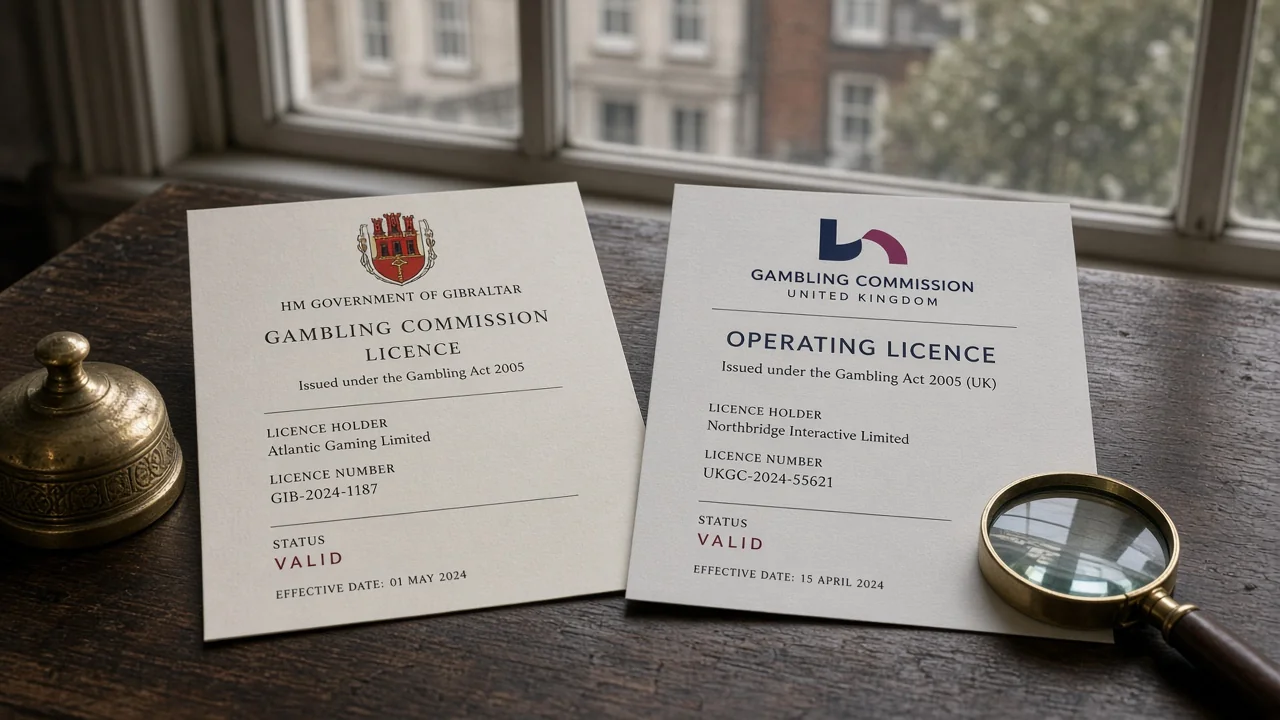
Step 1: Verify the licence yourself
A licence badge at the footer of a casino site proves nothing on its own. Find the operator’s name and licence number, then check them against the public register of the regulator that supposedly issued the licence. Confirm the domain listed in the register matches the site you are actually on — mismatches are a common trick. Operators without a UKGC licence cannot legally serve customers in Great Britain, so if you are considering a non-UK licensed casino, it operates entirely outside UK oversight, and the quality of the licence behind it is the main safety net you have.
Step 2: Read the bonus and withdrawal terms
The welcome offer is the least important part of the page. What matters is the conditions attached: wagering requirements, withdrawal limits, and the circumstances under which the casino can void a win or delay a payout. Non-UK licensed casinos are not bound by UKGC rules on bonus terms or advertising, so the terms are set entirely by the operator — and restrictive or unclear wording is a legitimate reason to walk away.
Step 3: Check payments and identity requirements
Look at what the site accepts for deposits and withdrawals, and in which currencies. Faster registration with minimal documentation is common at non-UK licensed casinos, but full identity verification frequently arrives only when you request a withdrawal — a point worth knowing before, not after, you win. Some of these sites accept credit cards, which UKGC-licensed casinos cannot. That is a flexibility, not a benefit: gambling on borrowed money carries risks regardless of where the licence comes from.
Step 4: Assess responsible-gambling support
Ask what the site offers if gambling stops being entertainment: deposit limits, time-outs, self-exclusion tools, and access to help. Non-UK licensed casinos have no obligation to enforce GamStop, and they are not affiliated with it — a self-exclusion registered with GamStop will not block you there. If you have excluded yourself through GamStop, this is the single most important fact on this page. UK-based support services such as GamCare, BeGambleAware and Gamblers Anonymous remain available to you regardless of where the casino is licensed.
The decision in one paragraph
Verify the licence with the regulator, not the logo. Read the withdrawal terms before the bonus terms. Know when identity checks will actually hit. Confirm what self-exclusion and deposit-limit tools exist. A casino that survives all four checks may still disappoint you; one that fails any of them has told you what you needed to know.
What is the fastest withdrawal method at new UK casino sites?
Non-UK casinos may process withdrawals within hours, and cryptocurrency transactions can be near-instant. The actual speed depends on the payment method and the casino’s processing procedures.
Can I use cryptocurrency at UKGC-licensed casino sites?
The provided information does not confirm whether UKGC-licensed casinos accept cryptocurrency. Non-UK casinos often support cryptocurrencies such as Bitcoin.
What is the fastest payment method for withdrawals?
Cryptocurrency can provide near-instant withdrawals at some non-UK casinos. However, the available methods and processing speed depend on the casino.
What is a UK gambling licence?
A UK gambling licence is a legal authorisation issued by the UK Gambling Commission to operators offering online gambling to consumers in Great Britain. It requires compliance with British rules on fairness, advertising, self-exclusion and dispute handling.
Who do I complain to about a UK casino?
Start with the casino’s internal complaints process, then escalate the matter to its licensing authority if necessary. For a non-UK casino, the relevant licensing body is the regulator that issued its licence, not the UK Gambling Commission.
Created by the ”Casinouk Game Info” editorial team.