
Gambling Casino Sites UK: Slots and Safety Guide
 Available in GB
A practical guide to licensing, real-money slots, bonuses, payments, live casino play and responsible gambling tools.

Table of Contents
- The UK Legal Framework: Licensing, Age Checks and Player Funds
- How to Compare UK Online Casinos Before You Sign Up
- Choosing Gambling Casino Sites for UK Slots in 2026
- Real-Money Slots: What UK Players Should Check First
- The Shortlist: UK Online Casinos and What Each Does Best
- Bonuses, Wagering Requirements and UK Payment Methods
- Live Casino Gambling in the UK: How It Differs from Slots
- Slot Machines, Free Play and Casino Apps
- Responsible Gambling Tools You Can Use on UK Casino Sites
- How to Keep Online Casino Gambling Safe and Free to Explore
The UK Legal Framework: Licensing, Age Checks and Player Funds
Before a single reel spins on a site aimed at British players, the operator behind it has to clear a set of legal hurdles that most customers never see. That framework is worth understanding first, because every other decision — which casino, which game, which bonus — sits on top of it. Get the foundation wrong and nothing else matters.
One licence decides everything
Online casinos operating in Britain must be licensed by the UK Gambling Commission. It doesn’t matter where the company is based: if the service is offered to consumers in Great Britain, the licence is required. The Gambling Act 2005 is the primary legislation, and the Commission, which took on its full powers in 2007, issues operating, personal and premises licences accordingly. For an online casino, the relevant document is a remote operating licence.
For a would-be operator, applying is not a formality. The Commission assesses identity and ownership, finances, integrity, competence and criminality. Application fees are non-refundable whether or not the licence is granted, and the standard processing time runs to roughly 16 weeks. In other words, a company has to spend real money and wait months before it can lawfully take a single bet.

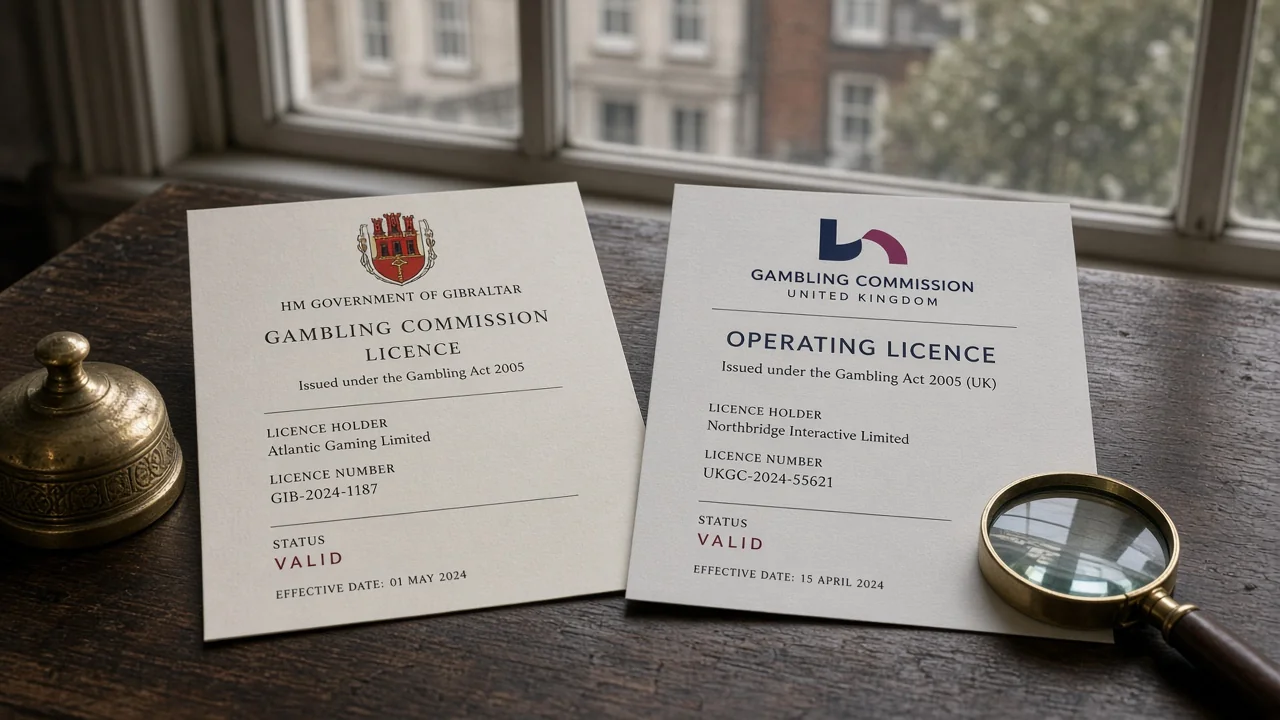
For you, the framework is simpler and entirely practical: anyone can check an operator’s licence on the official UK Gambling Commission register before signing up. Match the operator name or licence number on the casino’s site — the number should be published in the footer — against the public register, and confirm the domain listed there is the one you’re actually on. A licence number copied from another operator, or a site that hides it, tells you everything you need to know.
Age and identity verification
The legal gambling age in the UK is 18, and no one under that age may place a bet with a licensed operator. Enforcing that is not left to a checkbox ticked during registration. Licensed sites must verify age and identity before allowing deposits, which is why you’ll be asked for documents — proof of identity, proof of address — earlier than you might expect. It can feel intrusive. It is also the mechanism that keeps the site on the right side of the law and keeps your account defensible if anything goes wrong.
Where your money sits
A less visible rule matters as much as the licence. UKGC rules require player fund segregation: the money in your account must be held separately from the casino’s day-to-day operating money. If a licensee runs into financial trouble, your balance is not meant to be part of the general pot that creditors can claim. This is a regulatory requirement, not a courtesy — an unlicensed offshore site makes no such promise, and nothing compels it to.

The credit card ban
Since April 2020, credit card deposits have been banned at every licensed UK casino, according to the regulatory record. You cannot fund gambling on borrowed money through a licensed operator, full stop. The practical workarounds are the approved alternatives: debit cards, e-wallets, bank transfer, Apple Pay and PaysafeCard. If a site happily accepts your credit card for a deposit, that alone tells you it sits outside the UK system.
Fairness has to be audited
Beyond licensing and money handling, UK regulators require independent auditing of random number generators. The RNG is the engine that decides each outcome, and a licence obliges the operator to have it tested by parties with no stake in the results. This is what separates a regulated slot from a piece of software that behaves however its owner wants it to behave.
Why this framework comes first
New online gambling casinos appear in the UK market all the time — some genuinely licensed, others hoping you won’t check. The framework above is the filter that sorts them. A site with a verifiable UK Gambling Commission licence, working age checks, segregated player funds and audited RNGs has signed up to rules it cannot quietly opt out of. Everything the rest of this article covers — comparing game libraries, judging bonuses, choosing slots — assumes that filter has already been applied. Skip it, and you’re not choosing a casino; you’re choosing whether to have protections at all.
How to Compare UK Online Casinos Before You Sign Up
Two UK casino sites can both hold a valid UK Gambling Commission licence and still be completely different places to play. One may carry thousands of slots from a dozen studios; another may specialise in a tighter library with faster support. Neither is objectively better — what matters is whether the site matches how you actually play. This section sets out the criteria worth checking before you create an account, so the comparison is yours rather than someone else’s.
- Check the operator’s licence on the official UKGC register
- Verify that the domain matches the one listed on the register
- Confirm the operator name or licence number matches the site footer
- Trust a site that hides its licence number
- Sign up using a site that provides a copied licence number
- Assume a brand name is the same as the licensed entity
Start with the licence, not the bonus
Every comparison should begin with the same question: is this operator licensed by the UK Gambling Commission? A remote operating licence is required for any site serving players in Great Britain, and you can confirm it yourself in minutes. The UKGC maintains a public register where you can search by operator name or licence number and check that the domain listed there matches the one you’re about to deposit on.
Some comparison content goes a step further and looks at whether the site publishes its full UKGC licence number matched to the UK-registered operator entity behind the brand. That detail matters because the company holding the licence is the one legally accountable for your funds — the brand name on the homepage is often just marketing.
Game library: breadth is not the same as fit
Licensed online casinos differ meaningfully in game library size, deposit options, refunds and player protections — a distinction drawn consistently in independent operator reviews, and one worth taking seriously. A site with a huge slots catalogue is only useful if it includes the games you want to play. Before signing up, check three things:
- Which providers supply the site. The studios behind the games determine their mechanics, themes and, broadly, their quality.
- Whether the games you already know are present. If you have a shortlist of titles, search for them directly — most casinos have a search function, and testing it before registering tells you more than any landing page.
- How the library is organised. Filtering by provider, game type or features makes a large library usable; a wall of unsorted thumbnails does not.
Independent certification of the games
A UKGC licence already requires independent auditing of random number generators, but it’s worth knowing who does that testing. A dedicated casino review page identifies eCOGRA, iTech Labs and GLI as providers of independent RNG and RTP certification. If a casino displays a certificate from one of these testing houses, that’s a verifiable signal — each of them publishes audit information you can look up, rather than a badge you simply have to trust.
Payments: what you can use, and what you can’t
Check the cashier before you deposit, not after. Two points deserve early attention:
- Credit cards are banned. Credit card deposits have been banned at licensed UK casinos since 2020, so any site accepting them is either unlicensed or breaking the rules. Debit cards, e-wallets, bank transfer, Apple Pay and PaysafeCard are the legitimate alternatives.
- Withdrawal terms are separate from deposit terms. A payment method available for deposits isn’t always available for withdrawals, and withdrawals typically require identity verification. Look for the site’s stated withdrawal times and whether they match the method you’d actually use.
Player protections and the quality of the terms
Player protection is where licensed sites quietly diverge. All UKGC-licensed operators must provide tools for managing playing habits — deposit limits, breaks and self-exclusion options — but the implementation differs. Some make these tools prominent and easy to adjust; others bury them in account settings. Check where they live before you need them.
The same applies to bonus terms. Bonuses and associated winnings cannot be withdrawn until the applicable wagering requirement is completed, and the UKGC has banned reverse withdrawals that let players cancel a withdrawal and gamble the money back. Reading the full terms of any promotion before opting in will tell you whether the offer is structured for you or against you.
How professional comparisons are structured
If you’d rather start from a curated field than research every operator from scratch, it helps to know how the established comparison sites work. One widely used casino comparison service rates operators using a 50-point methodology across six weighted categories, identifying licensing and player protection, game library and providers, bonus value and wagering, and withdrawal speed and mobile experience among its rating criteria. It also compares UKGC-licensed operators on payout speed, bonus terms, game selection and responsible gambling controls.
Comparison Essentials
- Verify the UKGC licence and the legal operator entity
- Check for presence of preferred game providers and specific titles
- Look for independent RNG and RTP certification (e.g., eCOGRA)
- Confirm compatible payment methods for both deposits and withdrawals
- Locate and test responsible gambling tools like deposit limits
Knowing the structure matters more than knowing the scores. If a comparison service weights its categories differently from what you care about — say, it emphasises mobile experience while you play mainly on desktop — its rankings won’t fit you regardless of how rigorous they are. Use professional comparisons to narrow the field, then apply your own checks from the sections above to the finalists.
The short version
Before you hand over any personal details or money, verify the licence in the UKGC register, confirm the operator entity behind it, scan the game library for the titles you actually want, note who certifies the RNG, read the payment and withdrawal terms, and locate the responsible gambling tools. None of this takes long. All of it is published information. And a casino that makes any of it hard to find has already told you something.
Choosing Gambling Casino Sites for UK Slots in 2026
This shortlist provides a quick way to review UKGC-licensed casino operators for UK slots in 2026. Use the listed bonus, payout timing, and minimum deposit details to identify the options that fit your preferences.
License: UKGC Operator Licence · Bonus: £200 welcome bonus · Payout speed: Within 48 hours · Min. deposit: £10 32Red holds a UKGC Operator Licence and offers a £200 welcome bonus. Its minimum deposit is £10, with payouts stated as arriving within 48 hours.
License: UKGC Operator Licence · Bonus: £100 bonus · Payout speed: Within 24 hours · Min. deposit: £10 ProgressPlay Limited is a UKGC-licensed operator offering a £100 bonus. It has a £10 minimum deposit and states that payouts are made within 24 hours.
License: UKGC Operator Licence · Bonus: £20 bonus · Payout speed: Within 48 hours · Min. deposit: £10 Silverbond Enterprises operates under a UKGC Operator Licence and offers a £20 bonus. The minimum deposit is £10, with payouts stated as arriving within 48 hours.
License: UKGC Operator Licence · Bonus: £100 bonus · Payout speed: Within 24 hours · Min. deposit: £10 Genesis Global Limited is UKGC licensed and offers a £100 bonus. It lists a £10 minimum deposit and payout timing of within 24 hours.
License: UKGC Operator Licence · Bonus: £100 bonus · Payout speed: Within 24 hours · Min. deposit: £10 LeoVegas holds a UKGC Operator Licence and offers a £100 bonus. Its minimum deposit is £10, while payouts are stated to arrive within 24 hours.
License: UKGC Operator Licence · Bonus: £50 bonus · Payout speed: Within 48 hours · Min. deposit: £10 Platinum Gaming Limited is licensed by the UKGC and offers a £50 bonus. It has a £10 minimum deposit, with payouts stated as arriving within 48 hours.
Slots are the reason most people open a casino site in the first place, and slots are where the differences between operators show up fastest. Two licensed UK casinos can sit side by side in a search result, look nearly identical, and offer completely different experiences once you start spinning. This section is about how to tell them apart before you deposit — not which brand to pick, but which checks actually separate a good slots site from a merely large one.
Start With the Licence, Not the Lobby
Every casino serving UK residents must hold a UK Gambling Commission licence, and that licence is not a formality. It is the difference between a site that is legally required to make return to player (RTP) information available, to have its random number generators independently audited, and to keep your money separate from its own — and a site that owes you none of that. You can verify any operator in the Commission’s public register before you sign up, matching the licence number to the UK-registered entity behind the domain you are actually visiting. If the register and the site do not agree, close the tab. No slot library is worth that risk.
RTP: The One Number You Should Always Find
Return to player is the percentage of all wagered money a slot is designed to pay back over time. A slot with 95% RTP returns £95 for every £100 wagered — not to you on a Tuesday afternoon, but across a very long period and a very large number of plays. It is a statistical property of the game, not a promise about your session, and any site or headline that presents it otherwise is misleading you.
What RTP is genuinely useful for is comparison. Between two otherwise similar slots, the one with the higher RTP takes less of your money in the long run, and licensed sites are required to make that figure available rather than hiding it in a PDF nobody reads. Look for it in the game’s information screen, the site’s game pages, or the help section. A slots site that makes RTP easy to find is telling you something about how it treats players; one that buries it is telling you the same thing, less politely.
Independent testing houses exist to check that these numbers are honest. eCOGRA, iTech Labs and GLI certify random number generators and RTP figures for licensed operators, and their seals on a casino site mean the games have been audited by someone other than the people selling them.
Slot Selection: Where Libraries Stop Being Equal
A library of thousands of games sounds impressive and tells you almost nothing. What matters is whether the library contains the games you actually want to play and whether it keeps growing after you join.
Assessing Slot Selection
To ensure a library suits your needs, evaluate it through four lenses:
- Named titles: Search for specific games you already know.
- Providers: Check for established studios that ensure professional quality.
- Filters and search: Ensure the lobby is organised by provider or feature.
- Range of formats: Look for a mix of classics, Megaways, and jackpots.
A workable way to assess slot selection:
- Named titles. If you already know you want to play Book of Dead, Starburst or Big Bass Bonanza, search for them directly on the site before registering. A name in a search engine result is not the same as a name in the casino’s own lobby.
- Providers. The studios behind the games — the companies that design the reels, maths and bonus features — determine quality more than the casino brand on the door does. A site working with established providers is offering games that have been built and tested professionally; a lobby full of unfamiliar titles from studios you cannot verify deserves a second look.
- Filters and search. A good lobby lets you sort by provider, volatility or feature. A poor one dumps a thousand thumbnails on you and calls it a day. How a site organises its games is a reasonable proxy for how much thought went into everything else.
- Range of formats. Classic three-reel games, video slots, Megaways-style mechanics, jackpot slots — the mix matters if your taste sits outside the mainstream. A big library with no variety is just repetition with different artwork.
The difference between a broad library and a suitable one is simple: breadth is what a casino counts, suitability is what you count. A player who only ever touches high-RTP classics gains nothing from a site whose size comes entirely from variations of the same mechanic.
How Comparison Sites Rank Slots Operators
If you use a comparison or review site to narrow the field — and many people do before committing to a first deposit — it helps to know what is being measured. The review pages behind current shortlists of UKGC-licensed operators describe a scoring approach built on weighted categories: licensing and player protection, game library and providers, bonus value and wagering, withdrawal speed and mobile experience, scored on a fixed point scale. That category list is a reasonable checklist even if you never trust the scores themselves, because it mirrors the things that genuinely differ between licensed operators: game library size, deposit options, refunds and player protections.
The same caution applies in both directions. A review site earns money from the casinos it lists, so treat its rankings as a starting filter, not a verdict. The licence check in the UKGC register is the only step in this process you can verify entirely yourself, which is why it comes first.
What Changes in 2026
The fundamentals of choosing a slots site have not changed: licence, RTP transparency, audited games, a library that fits how you play. What shifts year to year is the surface — new studios entering the market, new mechanics, welcome offers being restructured around tighter bonus terms. The response is the same as it has always been. Check the licence, read the RTP, look for certification, and judge the lobby against your own shortlist of games rather than against a number on the homepage. A casino that survives those four checks is worth your attention. One that fails any of them has already answered your question.

Real-Money Slots: What UK Players Should Check First
Playing online slots for real money in the UK is a different activity from spinning a demo reel for five minutes. Once your own cash is on the line, a handful of practical details — RTP figures, payment rules, withdrawal eligibility — decide whether the experience is straightforward or frustrating. None of these details require expertise to check. They require five minutes before your first deposit.
RTP is a long-term average, not a promise
Return to player (RTP) is the figure licensed UK sites must make available for their games, and it is the most commonly misread number in gambling. A slot with 95% RTP returns £95 for every £100 wagered — but only over a very long period and a very large number of plays. It is a statistical property of the game, not a schedule for your session.
Read it correctly and RTP becomes useful: it tells you which games take a smaller structural share of total wagers over time, which lets you compare one slot against another on a like-for-like basis. Read it incorrectly — as an expectation for tonight — and it becomes a fast route to a bad decision. A single session can land anywhere. The number describes the game, not your luck.
Before Your First Deposit
- Find the RTP information for your intended game
- Match the operator’s licence and domain against the UKGC register
- Confirm your deposit method is also valid for withdrawals
- Complete your identity verification process early
- Use a payment method that uses your own funds, not credit
Two habits make the figure work for you. First, treat RTP as a comparison tool between games of the same type, not as a predictor of outcomes. Second, remember that the figure applies to total amount wagered, not to your starting balance. If you recycle winnings back into a game, you are wagering more than you deposited, and the long-run maths applies to all of it.
The credit card ban and what replaces it
You cannot fund a UK casino account with a credit card. The ban has applied to every licensed UK casino since April 2020, according to the industry review that tracks the change, and it covers deposits made to play slots just as it covers any other gambling product. The reasoning is simple: borrowing to gamble converts a loss into debt, and the regulator decided that combination should not be available through licensed channels.
The permitted alternatives are debit cards, e-wallets, bank transfer, Apple Pay and PaysafeCard. Each works slightly differently — a debit card draws on money you already hold, a PaysafeCard voucher caps your exposure to the value of the voucher — but all of them share one feature: they spend funds you actually have. The UKGC-licensed market is designed so that a deposit, once made, is funded rather than borrowed.
Verify the operator before the deposit, not after
The single most important check happens before any money moves. All licensed sites must verify your age and identity before allowing deposits, and you should verify them right back: match the operator’s name and licence number against the UK Gambling Commission’s public register, and confirm the domain listed there is the one you are actually using. This takes minutes and rules out the one category of site where none of the other protections on this page apply — unlicensed operators, which cannot legally advertise to UK consumers at all.

Verification is not a formality on your side either. Withdrawals typically require identity verification, and a player who deposits first and uploads documents later has simply deferred the process to the point where their money is already inside the account. Doing it early means that when a withdrawal request goes in, nothing is pending except the operator’s own processing.
Check withdrawal eligibility before you build a balance
Whether you can withdraw, and how, depends on decisions made before you play. Payment methods differ in cashout availability, and according to one operator review, most major UK-licensed operators accept PayPal for deposits and same-day cashouts. That claim is worth testing on the site you are about to use rather than assuming: check which of your deposit methods also appear on the withdrawal page, because an operator can accept a deposit method it does not pay out through.
Also worth knowing in advance: the UKGC has banned reverse withdrawals — the mechanism that once let players cancel a payout request and gamble the money back. Once you request a withdrawal at a licensed site, it stands. Combined with the rule that bonuses and associated winnings cannot be withdrawn until wagering is complete, this means the state of your account at the moment of withdrawal is what you get. Check the terms that shape that state — bonus conditions, method restrictions, verification status — while the balance is still zero.
What to do before your first deposit
- Find the RTP information for the game you intend to play, and read it as a long-run average.
- Confirm the operator’s licence number and domain against the UKGC register.
- Check that your deposit method is also a withdrawal method.
- Complete identity verification before, not after, you fund the account.
- Use a payment method that spends your own money — the credit card ban makes this the only legal option anyway.
None of this protects a bankroll from the game itself. It protects the player from the avoidable part: funding an unlicensed site, borrowing to play, or discovering a withdrawal is blocked by paperwork after the money is already in. In real-money gambling, the checks you skip before depositing are the ones that cost time afterwards.
The Shortlist: UK Online Casinos and What Each Does Best
The criteria in the previous sections — licence status, game selection, bonus terms, withdrawal speed, responsible gambling controls — only become useful when you apply them to actual operators. The shortlist below draws on a specialist casino review site that rates UK Gambling Commission-licensed operators across payout speed, bonus terms, game selection and player protection tools. Every operator featured there is described as holding an active UK Gambling Commission licence, and each publishes a full licence number matched to its UK-registered operator entity, which you can check against the UKGC’s public register before depositing anything.
Features no wagering requirements on bonuses, including 50 free spins.
Offers a standard 100% matched bonus up to £100 with 30x wagering.
Provides a large live casino selection and payouts within 24 hours.
Combines responsible gambling tools with a high-RTP slots library.
Rather than repeating each operator’s full profile, the point here is what each one does distinctly well — because the "best" casino for you depends on which of these strengths matches how you actually play.
PlayOJO — bonuses without wagering
PlayOJO’s distinguishing feature is its treatment of bonuses: the review presents it with no wagering on any bonus, and offers described include 50 free spins with zero wagering. In a market where bonus winnings are locked until a wagering requirement is completed, that structure removes the single most common source of player frustration. If bonus terms are what usually put you off signing up, this is the operator whose terms need the least decoding.
Casumo — a straightforward matched bonus
Casumo is presented with 30x wagering on its bonus, on an offer described as 100% up to £100. That is a conventional matched-bonus structure with a wagering requirement at the lower end of what the review site’s shortlist accepts. It suits players who want a standard welcome package and are prepared to read the terms rather than avoid them.
LeoVegas — live casino depth and fast payouts
LeoVegas is presented as having a large UK live casino selection and payouts within 24 hours. The shortlist as a whole is described as offering sub-24-hour payouts to PayPal, Skrill and Trustly, but LeoVegas pairs that speed with the strongest live dealer range of the group. If your interest runs beyond slots to real-time table games, this is where that preference is best served.

Mr Green — player protection and slot value
Mr Green is presented as having responsible gambling tools alongside a high-RTP slots library. The combination matters: return to player (RTP) information tells you what a slot returns over a very long period and many plays — a 95% RTP slot returns £95 for every £100 wagered, statistically — and a library built around higher-RTP games gives that figure more room to matter. Mr Green is the pick if slot value and self-management tools rank equally in your decision.
Betway — one account across sports and casino
Betway is presented as integrating sports and casino accounts. That sounds mundane until you’ve dealt with operators that keep the two as entirely separate wallets. For players who move between a football bet and a few spins, a single account is a genuine differentiator rather than a marketing line.
Grosvenor — high-street heritage
Grosvenor Casino is presented as having UK high-street brand heritage and an integrated live casino studio. For players who want an online operator with a physical presence behind the name, that lineage — plus live tables run from its own UK-based operation — sets it apart from pure online brands.
How to read this list
None of these operators wins on everything. PlayOJO leads on bonus fairness, LeoVegas on live play and payout speed, Mr Green on slot value and player controls, Betway on account simplicity, Grosvenor on brand continuity, and Casumo on a conventional bonus with terms worth reading. The independent RNG and RTP certification behind these sites — handled by bodies such as eCOGRA, iTech Labs and GLI — is shared infrastructure, not a differentiator, so treat it as a baseline you should expect from any licensed operator.
Shortlist Note
Review ratings reflect specific methodology and may vary; always verify current bonus terms and licences directly on the operator’s website.
One caution before you act on any shortlist, including this one: the review’s ratings reflect the site’s methodology, not a guarantee of your experience. Verify the licence on the UKGC register yourself, read the current bonus terms on the operator’s own site — offers change — and only deposit what you have already set aside as gambling money. A shortlist narrows the field; the final check is yours.
Bonuses, Wagering Requirements and UK Payment Methods
A bonus is only worth what its terms allow you to keep. Before you treat any casino bonus offer in the UK as free money, read the wagering requirement — the number of times you must stake the bonus (or the deposit plus bonus) before winnings from it can be withdrawn. Under UK Gambling Commission rules, bonuses and any winnings tied to them cannot be withdrawn until that requirement is completed. A larger headline amount with a heavier requirement can leave you worse off than a smaller one you can realistically clear.

The contrast is easiest to see at the extremes. A profiled casino review presents PlayOJO with 50 free spins carrying zero wagering — whatever they return is withdrawable. The same review presents Casumo with a 100% match up to £100 subject to 30x wagering. According to that comparison page, its shortlist holds bonus wagering at 30x or lower, with zero-wagering offers at one end of the range. Treat those figures as what one review reports, not as a market-wide ceiling — always confirm the current terms on the operator’s own site before depositing.
No-deposit offers deserve the same scrutiny. They look risk-free, but winnings attached to them are still bonus funds until wagering is met, and withdrawal will be blocked until then. The rule is identical whether you deposited or not.
Depositing and withdrawing in the UK
Credit card gambling has been banned across every licensed UK casino since April 2020, so the payment question is really about the alternatives:
- Debit cards — the default option at licensed sites
- E-wallets, including PayPal, Skrill and Trustly
- Bank transfer
- Apple Pay
- PaysafeCard
One profiled review reports that most major UK-licensed operators accept PayPal for deposits and same-day cashouts, and that its shortlisted operators pay out to PayPal, Skrill and Trustly within 24 hours. That is a claim from a single comparison page, so treat stated payout times as a review’s finding rather than a guarantee — the operator’s own withdrawal page is the deciding source.
Expect identity verification before your first withdrawal: it is a regulatory requirement, not the casino being difficult. Have your documents ready, and remember that reverse withdrawals — cancelling a payout to gamble the money back — are banned under UKGC rules. Once you request a withdrawal, it stands.
Live Casino Gambling in the UK: How It Differs from Slots
Slots and live dealer games sit in the same licensed casino, but they are built on different mechanics, and understanding the difference changes what you should expect from each.
What a live dealer game actually is
A slot is software you play alone: you press a button, a random number generator (RNG) determines the outcome, and the reels resolve. A live dealer game replaces that solitary loop with a real-time video stream. A human dealer — or a physical wheel, card shoe or dice mechanism — runs the game from a studio, and you place bets through an on-screen interface while the action unfolds on camera.
Live Dealer Games
Real-time casino games broadcast via video stream where a human dealer manages the action, such as roulette or blackjack, within a regulated environment.
The two formats are not as far apart as they look. Live dealer games combine those real-time video streams with regulated RNG or game mechanics, so the software still governs what the camera cannot: the shuffle behind the scenes, the timing, the bet resolution. The dealer is the presentation; the certified mechanics are the engine.
What that means in practice
The differences that matter to a player are mostly experiential:
- Pace. Slots resolve in seconds and never wait for you. Live tables follow the dealer’s rhythm, with set betting windows between rounds.
- Game range. Slots number in the hundreds on most sites; live casino gambling in the UK centres on a compact set of formats — roulette, blackjack, baccarat and game-show style tables.
- Interaction. You can chat to the dealer and, on many tables, see other players’ bets. A slot session is a private one.
- Minimum stakes. Live tables generally cost more per round than a slot spin, because a studio, staff and video infrastructure sit behind every hand.
Why the operator matters more here
The video stream adds a layer of infrastructure that a slot simply doesn’t have. Studios, dealers, streaming capacity — these are the things that separate a polished live product from a jittery one, and they are the reason live casino selection varies more between legal online casinos in the UK than slot libraries do, since thousands of slots are effectively rented from the same providers.
Operator reviews reflect that spread. One operator review highlights LeoVegas for a large UK live casino selection alongside payouts within 24 hours, while another points to Grosvenor Casino’s UK high-street brand heritage and an integrated live casino UK studio — a rare case of a British land-based identity carrying into the streamed product. These are single-review judgements, not an industry ranking, but they illustrate what to look at: how many tables run at the hours you actually play, whether the stream holds up on your connection, and how quickly winnings leave the site.
The licence still does the heavy lifting
None of the studio polish changes the legal position. Any site offering live casino online gambling in the UK needs a UK Gambling Commission licence, the same requirement that covers its slots. The dealer on screen doesn’t make the game more trustworthy than a slot — the licence does that. What the dealer adds is pace, atmosphere and a game that unfolds in front of you rather than inside a machine.
Slot Machines, Free Play and Casino Apps
The slot machine you play on a phone is the same game as the one on a desktop site. UK-licensed operators serve their slot libraries through the browser, and a growing number also offer dedicated apps. Neither route changes the underlying mechanics: every spin is driven by a random number generator, and the return to player (RTP) figure is set by the game, not by the device you hold.

That last point matters more than it sounds. Licensed sites are required to make Return to Player information available, so you can check the RTP of a slot whether you open it in an app or in a browser tab. A slot with 95% RTP returns £95 for every £100 wagered — over a very long period and many plays, not on your Tuesday evening. The number describes the game’s long-run behaviour, and it travels with the game wherever you launch it.
Free play is not a smaller version of gambling
Demo modes exist on many licensed UK sites, and they serve a genuinely useful purpose: you can learn a game’s bonus rounds, volatility and pacing without putting money at risk. Free play is also the honest way to satisfy curiosity about the slot machines themselves. Land-based venues offer the same spectacle in physical form — SkyCity’s Auckland Casino, for instance, has more than 2,000 slot machines on its floor — but there, every machine is played with real stakes. Online, the demo option lets you look before you commit.
Two caveats. First, free play still requires a licensed site. An unlicensed operator offering "demo" games has no independent auditing of its random number generators, so even the practice version tells you nothing. Second, demo wins are not a forecast. The outcome distribution feels familiar after free play, which is exactly why some players overestimate their readiness for the real-money version.
What to expect from an app
An app adds convenience — quicker access, notifications, a slot reserved on your home screen — but it adds nothing to the odds and removes nothing from the risks. Before installing, apply the same checks you would to the site itself: confirm the operator’s licence on the UK Gambling Commission’s public register, and check that the listed domain matches the app’s publisher. A clone app with a familiar logo is an old trick, and the licence register is the fastest way to catch it.
The Constant Factor
Regardless of whether you use an app, a browser, or play for free, the underlying game mechanics and the requirement for a UKGC licence remain the same.
Whether you play slots in a browser, in an app, or for free before betting, the game is the constant. The licence is what makes the rest of it worth trusting.
Responsible Gambling Tools You Can Use on UK Casino Sites
Responsible gambling is not a slogan on a casino site’s footer — on UK-licensed platforms it is a set of working controls that change what you can actually do with your account. Every operator holding a UK Gambling Commission licence must provide tools for managing playing habits, and knowing what those tools do before you need them is more useful than discovering them afterwards.
Deposit limits
A deposit limit caps how much money you can move into your account over a period you choose. Once set, the operator must enforce it: the limit applies whether or not you change your mind later. This is the most direct control available, because it intervenes at the moment of spending rather than after it. If you are trying mobile casino gambling in the UK for the first time, setting a limit before your first deposit is the single most effective habit to build.

Reality checks
Reality checks are timed reminders that appear on screen while you play. They tell you how long your session has lasted, which is easy to lose track of when a slot is running feature after feature. The reminder interrupts the game state — and that interruption is the point. A decision made with a session length in front of you is better informed than one made without it.
Breaks and time-outs
Shorter than self-exclusion, a break lets you lock yourself out of your account for a fixed period — a cooling-off window rather than a full stop. It suits the situation where you recognise you are chasing a losing session but do not want to close the account permanently.
GAMSTOP
GAMSTOP goes further than any single operator can. It allows you to exclude yourself from all licensed UK gambling sites for a chosen period, and licensed operators must honour self-exclusion requests by denying service to the customer who made them. Because it covers the whole licensed market at once, it removes the option of simply opening a new account elsewhere — the most common way a single-site exclusion fails. If you want to explore what different operators offer before committing, independent online casino reviews for UK players will flag which sites make these controls easy to find and adjust; some operators in a dedicated casino review are noted specifically for the quality of their responsible gambling tools.

Where to get help
Every licensed site must display information about help for gambling problems. Beyond the operators’ own pages, GambleAware and GamCare provide free support, and GAMSTOP handles market-wide exclusion. None of these tools win back money already spent. What they do is put a delay between the impulse and the action — and that delay is where most bad decisions get caught.
How to Keep Online Casino Gambling Safe and Free to Explore
Free play is the lowest-risk way to see what a casino actually offers. Most licensed UK sites let you spin slots in demo mode without depositing anything, and this is genuinely useful: you can check whether the game library, the interface and the mobile experience suit you before a single pound is at stake. But demo mode tells you nothing about withdrawals, verification or customer service — those only reveal themselves once real money is involved.
What free play does not remove is the licensing check. A demo game running on an unlicensed site is still an unlicensed site, and the protections that matter — age verification, segregated player funds, self-exclusion options — only exist where the UK Gambling Commission has oversight. Before you create an account anywhere, even just to play for free, look the operator up in the official UK Gambling Commission register. It takes a minute and settles the single most important question about the site.
The distinction worth holding onto is simple. Safety checks — licence, age verification, working responsible-gambling tools — are non-negotiable, whether you play with pennies or play for free. Responsible-gambling controls, from deposit limits to GAMSTOP, are there for when play stops being a pastime. The first set you confirm before signing up; the second set you set up while everything still feels fine, because that is when they are easiest to configure.
Exploring without depositing is a sound approach. Doing it on a licensed site is what makes it a safe one.
Is online casino gambling legal in the UK?
Yes, online casinos serving players in Great Britain must hold a UK Gambling Commission remote operating licence. You can verify the operator and its domain on the official UKGC register before signing up.
What is the best welcome bonus at a UK casino?
PlayOJO is presented with 50 free spins and no wagering, while Casumo offers 100% up to £100 with 30x wagering. Compare the wagering terms as well as the headline offer before depositing.
What are the requirements for obtaining a UK gambling licence?
The UK Gambling Commission assesses an applicant’s identity and ownership, finances, integrity, competence and criminality. Applications are subject to non-refundable fees and typically take roughly 16 weeks to process.
Can I use a credit card at a UK casino?
No, credit card deposits have been banned at licensed UK casinos since April 2020. Alternatives include debit cards, e-wallets, bank transfers, Apple Pay and PaysafeCard.
Is PayPal accepted at UK gambling sites?
Yes, most major UK-licensed operators accept PayPal for deposits and same-day cashouts. Shortlisted operators are also described as offering sub-24-hour payouts to PayPal.
How do I set deposit limits on UK casino sites?
Use the deposit-limit tools provided in your casino account. Deposit limits are listed alongside reality checks and GAMSTOP as responsible-gambling controls.
Which online casino has the fastest withdrawals in the UK?
LeoVegas is presented as offering payouts within 24 hours. More broadly, the shortlisted operators are described as offering sub-24-hour payouts to PayPal, Skrill and Trustly.
Published by the Casinouk Game Info team.